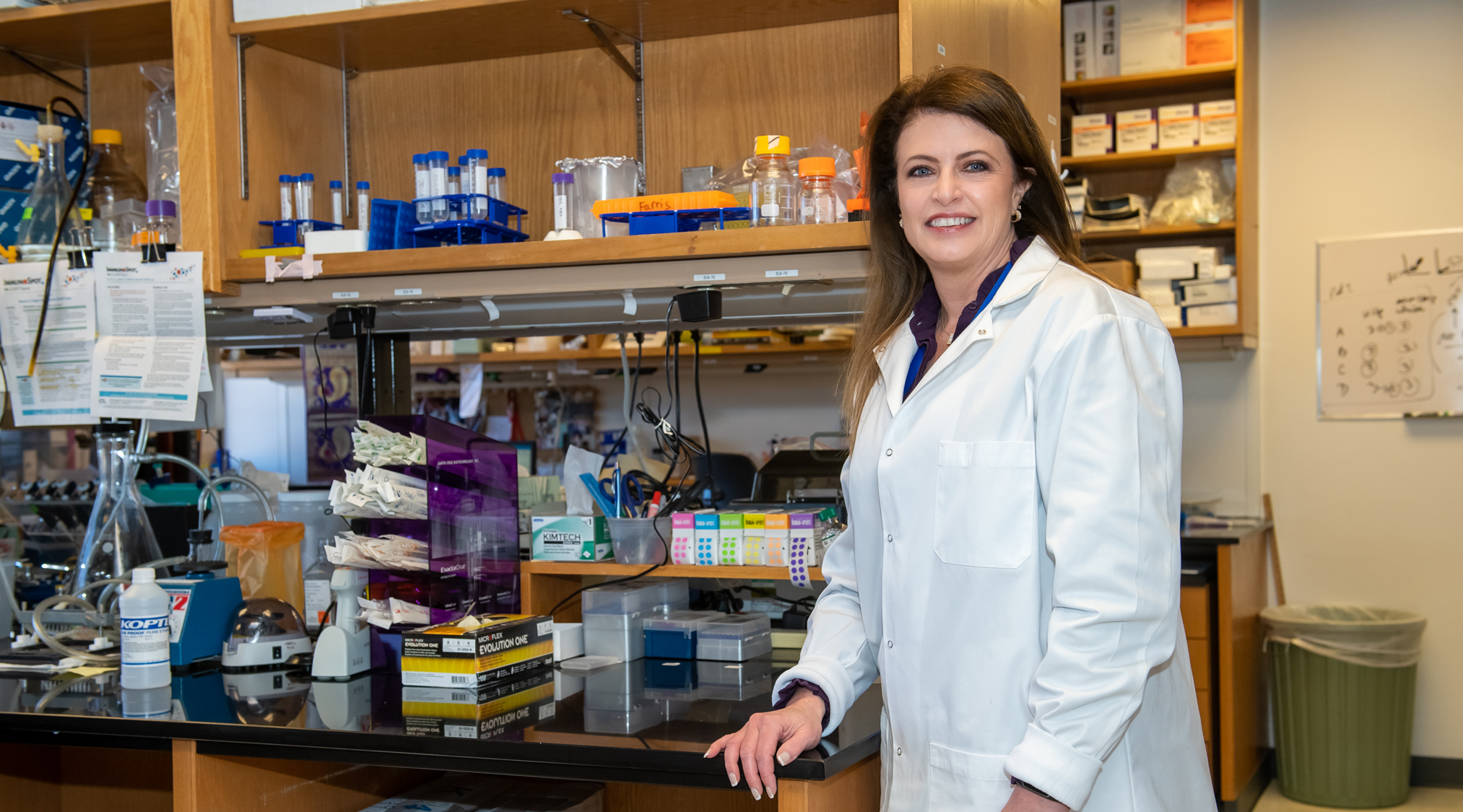
A. Darise Farris, Ph.D.
Professor
Arthritis & Clinical Immunology Research Program
Alvin Chang Chair in Biomedical Research
Adjunct Professor, Departments of Microbiology & Immunology and Pathology, University of Oklahoma Health Sciences Center
Director, Sjögren’s Research Clinic
My 101
My lab seeks to increase the understanding of basic disease processes using immunologic approaches. By uncovering the cellular and molecular basis of disease, we can take rational approaches to development of effective therapies. In the rheumatic disorder Sjögren’s syndrome (SS), we are applying new molecular tools to an old problem. Sjögren’s syndrome is a systemic rheumatic disease that selectively targets the moisture-producing salivary and lacrimal glands. Patients with Sjögren’s disease often have painful dry mouth and eyes, severe dental caries, fatigue, and arthritis. Why the salivary and lacrimal glands are involved in the disease process is a long-standing mystery. We are using single-cell molecular approaches to discover the substances and immune mechanisms that are causing the abnormal immune reactions occurring in salivary gland tissue from patients with SS.
Research
Sjögren’s syndrome (SS) is a systemic rheumatic disease that selectively targets the moisture-producing salivary and lacrimal glands. Patients with SS often have painful dry mouth and eyes, severe dental caries, fatigue, and arthritis. Why the salivary and lacrimal glands are involved in the disease process is a long-standing mystery. Our group is seeking to discover the substances and immune mechanisms that are causing the abnormal immune reactions occurring in salivary gland tissue from patients with SS. The approach we are using is to study gene expression of single immune cells isolated from salivary gland biopsy tissue from people who have SS. We are using lymphocyte receptors from the affected biopsy tissues to discover the substances, or antigens, causing their activation. So far, our work has identified a link between increased T helper cell clonal expansion, reduced salivary flow, and increased salivary gland damage.
Bacillus anthracis is a common organism occurring in the soil that can cause disease in farm animals. Unfortunately, spores from this organism, if inhaled into the lungs, can cause fatal disease in humans. An important risk of exposure in the modern world is bioterrorism. While vaccination and antibiotics are effective for preventing serious human disease, better therapeutic approaches are needed to improve the survival rates if people become sick through inhalational exposure. Our group has discovered that this bacterium can inhibit one of the most important functions of macrophages: disposal of dead cells. Chronic impairment of this process is well known for promoting autoimmune responses in autoimmune diseases like lupus and SS. We think that impairment of this process during bacterial infections of the blood may amplify inflammation, leading to or worsening a potentially fatal complication known as sepsis. We are currently identifying the molecular mechanisms that Bacillus anthracis uses to inhibit the disposal of dead cells and seeking ways to counteract these effects.
Brief CV
Education
B.S., Oklahoma Christian University of Science and Arts (summa cum laude), 1990
M.S., University of Oklahoma Health Sciences Center, 1993
Ph.D., Immunology, University of Oklahoma Health Sciences Center, 1995
Postdoctoral Studies, University of Melbourne, Melbourne, Australia, 1998
Honors and Awards
National Arthritis Foundation Postdoctoral Fellow, 1997 – 1999
OMRF Merrick Young Investigator Award, 2002
NIH K02 Independent Scientist Award, 2002 – 2007
Henry Kunkel Society, Invited Member, Inducted April 21, 2010
Oklahoma Christian University Biological Sciences Distinguished Alumnus Award, 2015
American Association of Immunologists Travel Award to the 26th International Congress of Immunology in Melbourne, Australia, 2016
Rheumatology Research Foundation Innovative Grant Award, 2017 – 2019
Merrick Award for Outstanding Medical Research, 2018
Professional Activities
Grant reviews: Ad hoc Member, NIAMS AMS Panel, remote meeting (2020); Ad hoc member, NIAMS 2020/21 AMS Panel (2019); Standing Member, Oral Dental and Craniofacial Sciences Study Section (2015-2019); Reviewer, 2017/06 ZRG1 MOSS K(57) SEP (2017); Reviewer and Co-Chair, 2016/05 ZRG1 MOSS-K (57) SEP (2016); Ad hoc reviewer for NIH standing study sections and special emphasis panels on 9 occasions between 2001-2014; VA Merit Grant Reviewer for Department of Veteran’s Affairs (1999)
Journal reviews (since 2000 in alphabetical order): Annals of Rheumatic Diseases, Heliyon, Antimicrobial Agents and Chemotherapy, Arthritis and Rheumatism/Arthritis and Rheumatology, Autoimmunity, Basic & Clinical Pharmacology & Toxicology, BMC Infectious Diseases, Cell Research, Cell Physiology and Biochemistry, Clinical and Experimental Immunology, Clinical and Translational Medicine, Clinical Ophthalmology, Clinical Rheumatology, Current Rheumatology Reviews, Endocrine, Metabolic & Immune Disorders-Drug Target, European Journal of Pharmacology, Expert Opinion on Drug Discovery, Frontiers in Immunology, Heliyon, Histochemistry and Cell Biology, Immunology and Cell Biology, International Immunology, International Journal of Immunogenetics, International Journal of Rheumatic Diseases, JCI Insight, Journal of Immunology, Journal of Infection, Journal of Leukocyte Biology, Journal of Molecular Recognition, Medical Microbiology & Immunology, Medical Sciences, Molecular Immunology, Molecular Therapy-Methods & Clinical Development, Nature Communications, Nature Immunology, Nature Medicine, Open Biomarkers Journal, Oral Diseases, PLoS One, PLoS Pathogens, Scandinavian Journal of Immunology, Scandinavian Journal of Rheumatology, Science Advances, Scientific Reports, Tissue Antigens, Vaccine
Society service: Abstract Selection Committee, Sjogren’s syndrome category, American College of Rheumatology Annual Meeting (2020 & 2021); Session Chair, “Autoimmunity 3”, International Congress of Immunology, Melbourne Australia (2016); Co-chair, Concurrent Session “Sjögren’s Syndrome I: Basic Insights”, American College of Rheumatology Annual Meeting, (2015); Abstract Selection Committee, Sjögren’s syndrome category, American College of Rheumatology Annual Meeting (2015); Chair, Block Symposium “Genetic Susceptibility to Autoimmune Disease”, American Association of Immunologists National Meeting (2013); Co-chair, Sjögren’s Syndrome Study Group, American College of Rheumatology Annual National Meeting (2008), Co-chair, Concurrent Session “Roles for Apoptosis in Systemic Rheumatic Disease”, American College of Rheumatology Annual National Meeting (2002)
Educational Activities: Lecturer: Advanced Immunology Course, Department of Microbiology and Immunology, University of Oklahoma Health Sciences Center (OUHSC); Graduate Program in the Biological Sciences (GPiBs) 2nd year curriculum, OUHSC; Pathobiology Course, Department of Pathology, OUHSC
Mentoring of Students:
PhD Candidates, GPiBs rotating graduate students, undergraduate Honors Thesis Students, OMRF Fleming Scholars Summer Research Program, OMRF Fulbright Scholars Program
Institutional Committees:
OUHSC PhD Thesis Committees (Chair and Member, 2005-present); OUHSC Graduate Program in Biological Sciences Student Interviews (2013-present); OMRF Graduate Education Committee (2003-present); Coordination of Arthritis and Clinical Immunology Dept. seminars (2002-2021); OMRF Institutional Animal Care and Use Committee (2003-2015)
Memberships
American Association of Immunologists, 1999-present
American College of Rheumatology, 2000-present
American Society of Microbiology, 2008-present
Henry Kunkel Society, 2010-present
Joined OMRF scientific staff in 1999
Publications
Recent Publications
Mytych JS, Pan Z, Lopez-Davis C, Redinger N, Lawrence C, Ziegler J, Popescu NI, James JA, Farris AD. Peptidoglycan from Bacillus anthracis Inhibits Human Macrophage Efferocytosis in Part by Reducing Cell Surface Expression of MERTK and TIM-3. Immunohorizons 8:269-280, 2024 March, PMID: 38517345, PMCID: PMC10985058
Brito-Zerón P, Flores-Chávez A, Ng WF, Fanny Horváth I, Rasmussen A, Priori R, Baldini C, Armagan B, Özkiziltaş B, Praprotnik S, Suzuki Y, Quartuccio L, Hernandez-Molina G, Abacar K, Bartoloni E, Rischmueller M, Reis-de Oliveira F, Fernandes Moça Trevisani V, Jurcut C, Fugmann C, Carubbi F, Hofauer B, Valim V, Pasoto SG, Retamozo S, Atzeni F, Fonseca-Aizpuru E, López-Dupla M, Giacomelli R, Nakamura H, Akasbi M, Thompson K, Szántó A, Farris AD, Villa M, Bombardieri S, Kilic L, Tufan A, Perdan Pirkmajer K, Fujisawa Y, de Vita S, Inanc N, Ramos-Casals M, Sjögren Big Data Consortium. Exposure to air pollution as an environmental determinant of how Sjögren's disease is expressed at diagnosis. Clin Exp Rheumatol, 2023 November, PMID: 38019154
Flores-Chávez A, Brito-Zerón P, Ng WF, Szántó A, Rasmussen A, Priori R, Baldini C, Armagan B, Özkiziltaş B, Praprotnik S, Suzuki Y, Quartuccio L, Hernández-Molina G, Inanc N, Bartoloni E, Rischmueller M, Reis-de Oliveira F, Fernandes Moça Trevisani V, Jurcut C, Nordmark G, Carubbi F, Hofauer B, Valim V, Pasoto SG, Retamozo S, Atzeni F, Fonseca-Aizpuru E, López-Dupla M, Giacomelli R, Nakamura H, Akasbi M, Thompson K, Fanny Horváth I, Farris AD, Simoncelli E, Bombardieri S, Kilic L, Tufan A, Perdan Pirkmajer K, Fujisawa Y, De Vita S, Abacar K, Ramos-Casals M, Sjögren Big Data Consortium. Influence of exposure to climate-related hazards in the phenotypic expression of primary Sjögren's syndrome. Clin Exp Rheumatol, 2023 November, PMID: 38019164
Selected Publications
Joachims ML, Leehan KM, Dozmorov MG, Georgescu C, Pan Z, Lawrence C, Marlin MC, Macwana S, Rasmussen A, Radfar L, Lewis DM, Stone DU, Grundahl K, Scofield RH, Lessard CJ, Wren JD, Thompson LF, Guthridge JM, Sivils KL, Moore JS, Farris AD. Sjögren’s syndrome minor salivary gland CD4+ Memory T cells associate with glandular disease features and have a germinal center T follicular helper transcriptional profile. J Clin Med. 2020 Jul 8;9(7):E2164. doi: 10.3390/jcm9072164. PMID: 32650575 PMCID: PMC7408878
Joachims ML, Leehan KM, Lawrence C, Pelikan RC, Moore JS, Pan Z, Rasmussen A, Radfar L, Lewis DM, Grundahl KM, Kelly JA, Wiley GB, Shugay M, Chudakov DM, Lessard CJ, Stone DU, Scofield RH, Montgomery CG, Sivils KL, Thompson LF, Farris AD. Single-cell analysis of glandular T cell receptors in Sjögren's syndrome. JCI Insight. 2016 Jun 2;1(8). pii: e85609. PMID: 27358913 PMCID: PMC4922426
Pan Z, Dumas EK, Lawrence C, Pate L, Longobardi S, Wang X, James JA, Kovats S, Farris AD. Bacillus anthracis Edema Toxin Inhibits Efferocytosis in Human Macrophages and Alters Efferocytic Receptor Signaling. Int J Mol Sci. 2019 Mar 7;20(5). pii: E1167. PMID: 30866434; PMCID: PMC6429438
Leehan KM, Pezant NP, Rasmussen A, Grundahl K, Moore JS, Radfar L, Lewis DM, Stone DU, Lessard CJ, Rhodus NL, Segal BM, Kaufman CE, Scofield RH, Sivils KL, Montgomery C, Farris AD. Fatty infiltration of the minor salivary glands is a selective feature of aging but not Sjögren’s syndrome. Autoimmunity. 2017 Dec:50(8):451-7. doi: 10.1080/08916934.2017.1385776. Epub 2017 Oct 8. PMID: 28988489. PMCID: PMC5730459
Leehan KM, Pezant NP, Rasmussen A, Grundahl K, Moore JS, Radfar L, Lewis DM, Stone DU, Lessard CJ, Rhodus NL, Segal BM, Scofield RH, Sivils KL, Montgomery C and Farris AD. Minor salivary gland fibrosis in Sjögren’s syndrome is elevated, associated with focus score and not solely a consequence of aging. Clin Exp Rheumatol. 2018 May-Jun;36 Suppl 112(3):80-88. Epub 2017 Oct 23. PMID: 29148407; PMCID: PMC5913007
Yaciuk JC, Pan Y, Schwarz K, Pan ZJ, Maier-Moore JS, Kosanke SD, Lawrence C, Farris AD. Defective selection of thymic regulatory T cells accompanies autoimmunity and pulmonary infiltrates in Tcra-deficient mice double transgenic for human La/Sjogren's syndrome-B and human La-specific TCR. J Immunol. 2015 Feb 15;194(4):1514-22. PMID: 25582858 PMCID: PMC4323622
Contact
Arthritis & Clinical Immunology Research Program, MS 24
Oklahoma Medical Research Foundation
825 N.E. 13th Street
Oklahoma City, OK 73104
Phone: (405) 271-7389
Fax: (405) 271-4110
E-mail: Darise-Farris@omrf.org
For media inquiries, please contact OMRF’s Office of Public Affairs at news@omrf.org.
Lab Staff
Michelle Joachims, Ph.D.
Staff Scientist
Jadith Ziegler, Ph.D.
Assistant Staff Scientist
Christina Lawrence
Research Technician IV
Cherilyn Pritchett Frazee
Research Technician IV
Savannah Beakley
Research Technician II
Charmaine Lopez-Davis
Research Technician II
Hope Christakos
Research Technician
Wesley "Wes" Daniel
Data Entry Clerk
Linda Prince
Laboratory Assistant
Ananth "Adi" Jupudi
Graduate Student
Josh Mytych
Graduate Student
Fathia Akamazina
Graduate Student
Louise Williamson
Finance and Administrative Specialist


News from the Farris lab



When a team of OMRF scientists set out to improve the anthrax vaccine, they started with a theory everybody thought would work: Break apart the toxins so they can’t enter cells. Problem solved. But things don’t always work as expected. In fact, the theory doesn’t work at all, according to a paper by OMRF’s Darise […]


A new study from OMRF has discovered that lurking in the bodies even of healthy people are numerous rogue immune cells, the cause of rheumatoid arthritis and a host of other diseases. The new findings could be key to developing new ways to prevent and treat autoimmune diseases, conditions like rheumatoid arthritis, lupus and type […]
Connor Fullenwider, a 2005 graduate of Muskogee High School, will spend his summer vacation as a Presidential Scholar at OMRF. Fullenwider, currently a sophomore at the United States Naval Academy in Annapolis, Md., will complete a research project focused on the study of anthrax under the guidance of Darise Farris, Ph.D., in OMRF’s Arthritis and […]
Nearing the mid-point of an historic five-year research project, the Oklahoma Medical Research Foundation announced today that it is making important strides toward developing more effective vaccines and treatments for the deadly infectious disease anthrax. In a study involving 120 military personnel, Judith James, M.D., Ph.D., Sherry Crowe, Ph.D., and Darise Farris, Ph.D., have identified […]
Oklahoma Medical Research Foundation scientist John Harley, M.D., Ph.D., has been named the inaugural recipient of a mentoring award from the nation’s leading rheumatology organization. Harley will be honored in Washington D.C. during the 70th Annual Scientific Meeting of the American College of Rheumatology (ACR) Research and Education Foundation. The new Excellence in Investigative Mentoring […]