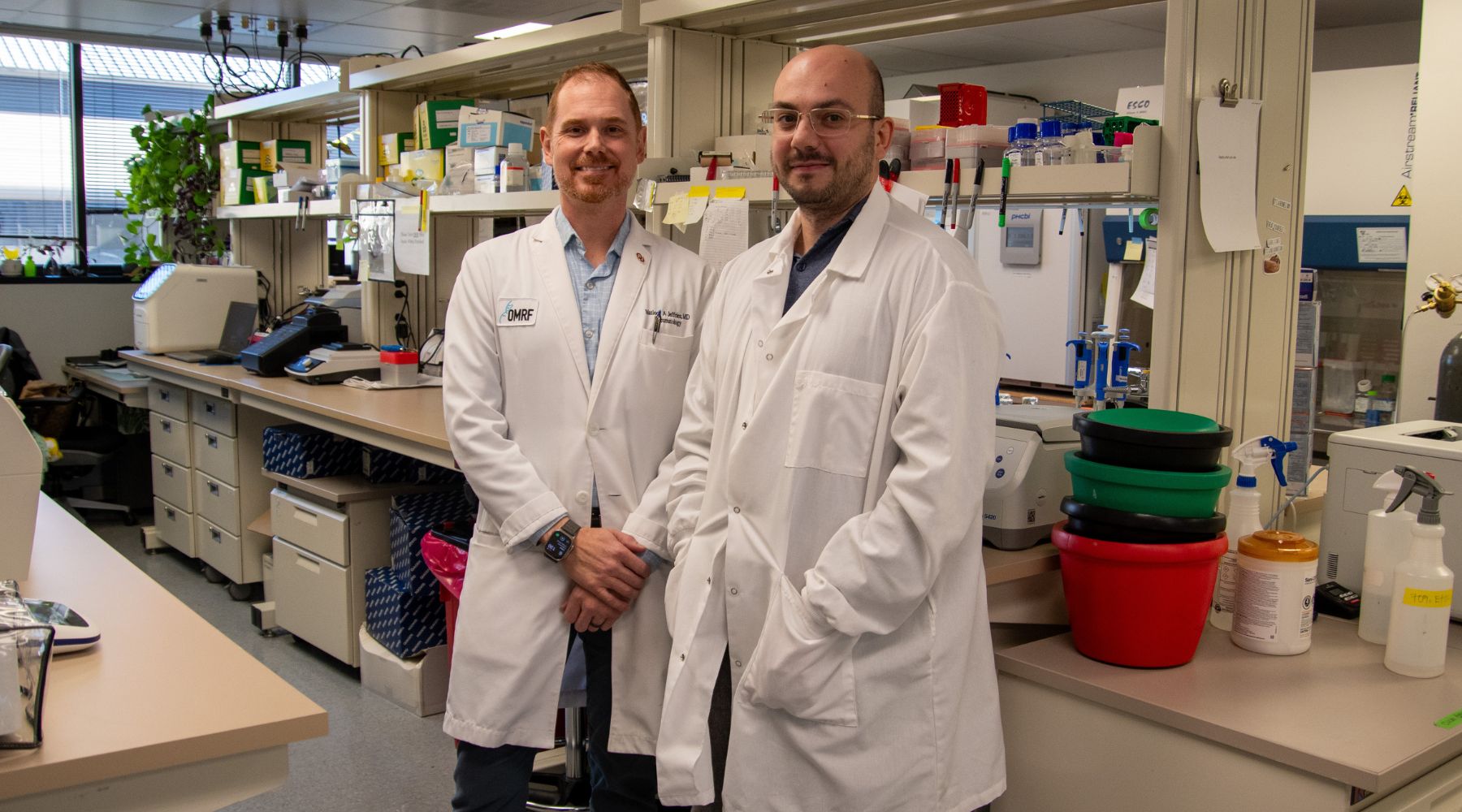
An Oklahoma Medical Research Foundation scientist has received a two-year National Institutes of Health grant to explore the root cause of debilitating infections that can follow joint replacement surgery.
Aleksander Szymczak, Ph.D., will investigate whether these post-operative infections are triggered by the microbiome – tiny communities of bacteria, fungi and viruses that live in our bodies.
“It happens several thousand times a year in the U.S., in up to 2% of all hip and knee replacement surgeries,” said Szymczak, a postdoctoral researcher who is training at OMRF with physician-scientist Matlock Jeffries, M.D. “For the patient, treating them can be crippling, both physically and financially.”
According to a 2021 study, hospital costs related to these infections are expected to reach nearly $2 billion in the U.S. by 2030.

“It’s a huge deal,” said Jeffries, a rheumatologist who’s seen patients endure a joint replacement infection. “It’s tricky to diagnose, and once you diagnose it, you can’t treat it with antibiotics. That new joint hardware must be removed and replaced with a temporary antibiotic spacer for several months while the area recovers. Usually that means they rely on a wheelchair or crutches.”
After recovery, the surgeon may try again to install a new joint. However, the rate of infection is significantly higher following these second attempts. Jeffries hopes Szymczak’s study will provide context to that phenomenon.
“One common belief is that something happens during the surgery that allows bacteria to get into the wound and cause an infection,” he said. “We suspect something different: that bacteria already living in the body put some patients at high risk for infection, which would explain why they would get an infection following both the first and second attempts.”
To test that hypothesis, Szymczak will analyze samples of blood, cartilage, synovial fluid and fecal material – all of which have separate microbiomes. The samples, collected before and during surgery, are provided by Paul Jacob, D.O., an orthopedic surgeon at the Oklahoma Joint Reconstruction Institute in Oklahoma City.
If the scientists’ hypothesis is correct, it will provide a better understanding of how these infections occur. The study also could lead to a diagnostic test that helps physicians either advise against joint replacement for high-risk patients or prescribe pre-surgical antibiotics to reduce the chance of infection.
Szymczak also will study bacteriophages — viruses that specifically infect bacteria — in the context of arthritis, as these viruses have not previously been widely studied in arthritis patients.
His grant, No. K99AR086336-01, was awarded by the National Institute of Arthritis and Musculoskeletal and Skin Diseases, part of the NIH.