For more than 20 years, scientists and physicians have studied how stem cells might repair tissue damaged during a heart attack. One major challenge: These cells, grown in a lab, often become genetically abnormal, making them useless for transplantation.
A recent discovery by scientists at the Oklahoma Medical Research Foundation provides a path toward a solution. Ultimately, this breakthrough could open new treatment avenues for pluripotent stem cells, so named for their ability to morph into any cell type in the body.
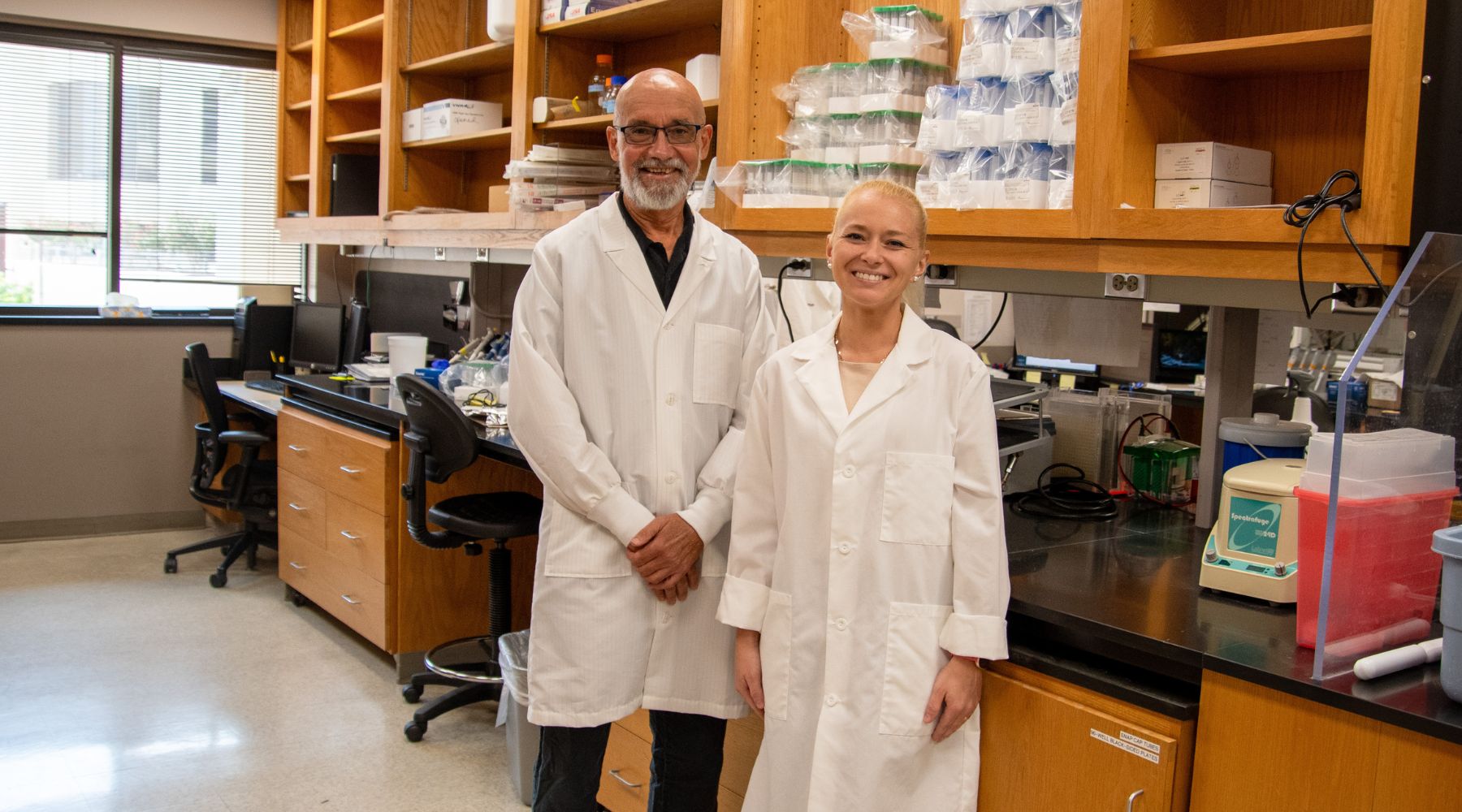
“If tissue in the heart or some other organ has died, these healthy stem cells blend in and become healthy tissue over time,” said scientist Gary Gorbsky, Ph.D. “They offer incredible potential to the future of regenerative medicine.”
Gorbsky’s lab conducts fundamental research into errors that can occur during cell division. Its goal is to lay the groundwork for new therapeutic medical treatments.
“Malfunctions in cells are the cause of almost all diseases,” said Gorbsky, who holds the W.H. and Betty Phelps Chair in Developmental Biology at OMRF. “The overarching premise of our work is understanding what causes some of these malfunctions.”
In this study, Maria Narozna, Ph.D., a postdoctoral researcher in Gorbsky’s lab, found a surprising origin to a genetic disorder called trisomy 12, which occurs when there’s an extra copy of the 12th chromosome. This error can occur within the body and is associated with certain types of cancer. The problem is also especially common in pluripotent stem cells, which are cells taken from an area like the skin and then grown in a lab.
“Scientists have long believed trisomy 12 begins as a single aberrant cell that spreads by growing faster,” Narozna said. “Our study showed that it actually takes place in a burst of many cells at once, so it’s more of a coordinated takeover rather than a rare accident.”
Gorbsky and Narozna are now conducting research aimed at preventing this wave of errors. Success could help accelerate several ongoing clinical trials involving pluripotent stem cells, including those to repair heart tissue.
Following a heart attack, the affected area begins to die, and scar tissue forms over it. Multiple studies have shown promise in transplanted pluripotent stem cells integrating with damaged heart tissue.
More than 100 other clinical trials are testing pluripotent stem cells for conditions including age-related macular degeneration, type 1 diabetes, Parkinson’s and spinal cord injuries.
“The promise of pluripotent stem cells is enormous,” Gorbsky said. “We hope our lab’s finding brings that promise closer to reality.”
This discovery was published recently in The Journal of Cell Biology. The research was supported by: the Oklahoma Center for Adult Stem Cell Research, a program of the Tobacco Settlement Endowment Trust; the McCasland Foundation; and grant No. R35GM126980 from the National Institute of General Medical Sciences, part of the National Institutes of Health.