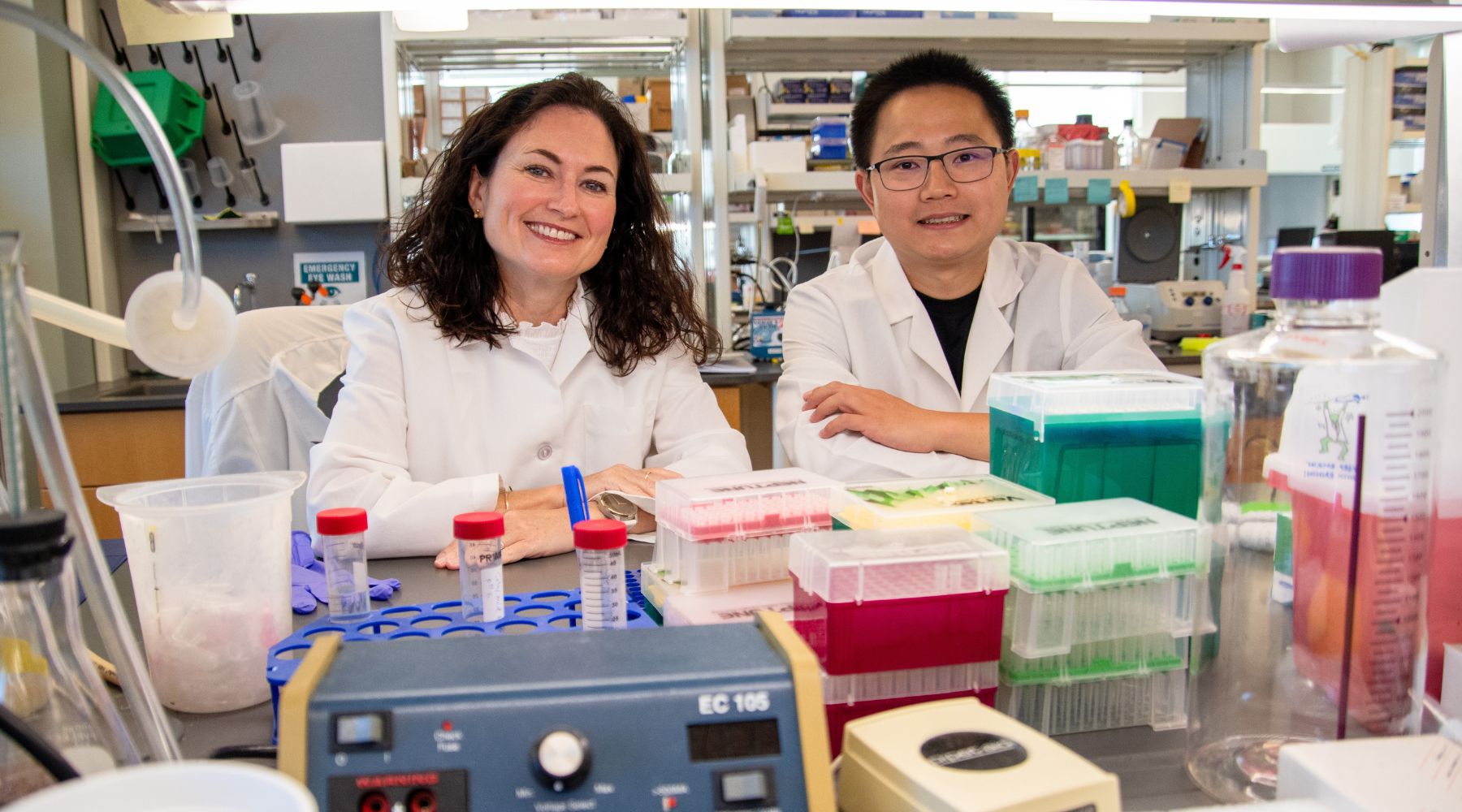
A discovery from the Oklahoma Medical Research Foundation could prevent vision loss in babies born prematurely and in people with diabetes.
The new findings by Courtney Griffin, Ph.D., and Eric Ma, Ph.D., hold the potential for developing drugs to prevent or treat diabetic retinopathy and retinopathy of prematurity (ROP), both of which damage the retina and can lead to blindness.
“Our vision is so fundamental to how we interact with the world,” said Griffin, who holds the Scott Zarrow Chair in Biomedical Research at OMRF. “Anything we can do to prevent these diseases from progressing to the point of vision loss would be a game-changer.”
Griffin, a cardiovascular biologist and OMRF’s vice president of research, performed experiments to better understand what causes these eye disorders.
Of the two conditions, diabetic retinopathy is far more common. In America, it affects more than a quarter of people with type 1 or type 2 diabetes – about 10 million people in all. By comparison, ROP affects about 14,000 preterm U.S. newborns per year.
Griffin’s lab identified a crucial hallmark of the two disorders through separate experiments involving mice and human eyes donated through an eye bank.
“Both conditions begin with the retinal blood vessels breaking down, which leads to the formation of abnormal new blood vessels,” said Ma, a postdoctoral researcher in Griffin’s lab who performed much of the work on the project. “Our study found that the breakdown of healthy blood vessels is preceded by the disappearance of two important proteins.”
Griffin and Ma suspected that if the absence of these proteins led to the disorders, then adding one might provide a remedy. They proved this theory by using a mouse model genetically engineered to produce extra amounts of one of the proteins, known as ERG.
“This extra ERG stopped blood vessel loss and the formation of abnormal vessels, which ultimately improved the vision problems,” Griffin said.
The prevention or remedy for either condition could be a new drug that adds ERG or one that prevents the protein’s degradation, Ma said.
Griffin and Ma now plan to test compounds that could stop ERG from breaking down.
“If we can develop an intervention, we can protect the retina in the early stages,” Griffin said. “The potential for such a life-changing outcome is what drives our research.”
Griffin and Ma published the new findings this week in The Proceedings of the National Academy of Sciences. The research was supported by grant Nos. R35HL144605 from the National Heart, Lung and Blood Institute and P20GM139763 from the National Institute of General Medical Sciences, both of which are part of the National Institutes of Health, and by grants from the American Heart Association and the ARVO Foundation for Eye Research.