Rare diseases affect an estimated 300 million people worldwide – so many that the last day of February is set aside each year to recognize them.
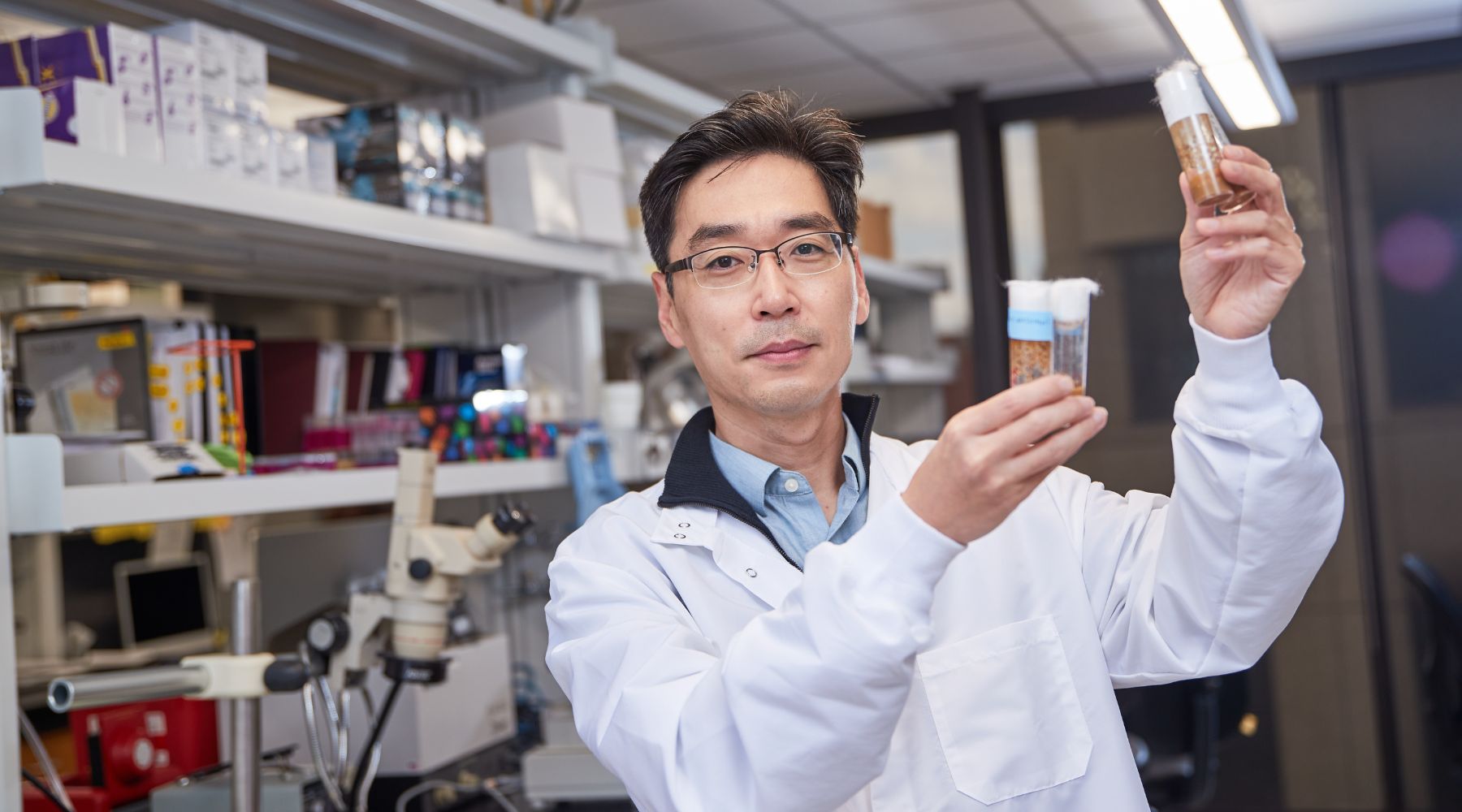
For Oklahoma Medical Research Foundation scientist Wan Hee Yoon, Ph.D., this year’s Rare Disease Day carries more significance than usual. It comes the same week that The American Journal of Human Genetics published his lab team’s discovery of an ultra-rare neurological disease.
Yoon led an international coalition of scientists who found that mutations of a single gene, NRDC, caused the disorder. In the process, they identified 16 children afflicted with it.
This marks Yoon’s fifth discovery of a rare neurological disease, each caused by separate gene mutations. As with the previous four, this disease has devastating neurological effects.
For Yoon, whose lab focuses on unraveling mysteries like this one, the discovery culminates 14 years of study into NRDC.
His research began in 2012, when Yoon, working as a postdoctoral fellow at the Baylor College of Medicine, discovered severe neurological issues in fruit flies bred with a mutation of NRDC. Four years later, a California boy was found through genetic testing to have a mutation of the same gene.
“But with just one known case at that time, we couldn’t prove that this mutation caused his condition,” Yoon said.
In 2021, a second case was confirmed in Turkey. This drew scientists from eight other countries to begin examining the effects of missing or malfunctioning NRDC genes.
Collaborating with Yoon, they found that fruit flies without a working version of this gene died early. But when scientists gave them a normal NRDC gene, the flies survived.
They have since found that 14 more children, primarily in Middle Eastern countries, had the same disease-causing mutation in NRDC. All had profound intellectual disability and abnormally small brains. Six died before their first birthday, and three others died before turning 3.
“Dr. Yoon excels at the painstaking, prolonged science necessary to identify the mutations behind these rare, incapacitating conditions,” said Benjamin Miller, Ph.D., who chairs OMRF’s Aging & Metabolism Research Program.
While Yoon’s latest discovery is neither a cure nor a treatment for the rare, unnamed disease, it cast light on mysteries that will need to be solved for those one day to become possible. “In that sense, our discovery moved us one step further in understanding how the human body works,” he said.
Yoon’s research was supported by grant No. R01 NS121298 from the National Institute of Neurological Disorders and Stroke, part of the National Institutes of Health, and by the Oklahoma Center for Adult Stem Cell Research, a program of the Tobacco Settlement Endowment Trust.