A powerful new technology developed at the Oklahoma Medical Research Foundation could dramatically speed up the process of diagnosing rare genetic diseases.
The breakthrough is a collection of biological tools that will enable scientists to precisely recreate patient-specific genetic mutations in research models. Physicians will then be able to use this information to diagnose and guide the treatment of patients living with rare diseases, a group that numbers approximately 30 million in the U.S. alone, according to the U.S. Food and Drug Administration.
When doctors discover an unusual genetic variant in a patient with an unidentified or rare medical condition, they often face a challenging question: Did this mutation cause the patient’s symptoms, or is it simply a harmless variation? With thousands of potential disease-causing mutations identified each year, scientists need efficient ways to determine which ones truly matter. The new technology addresses this need.
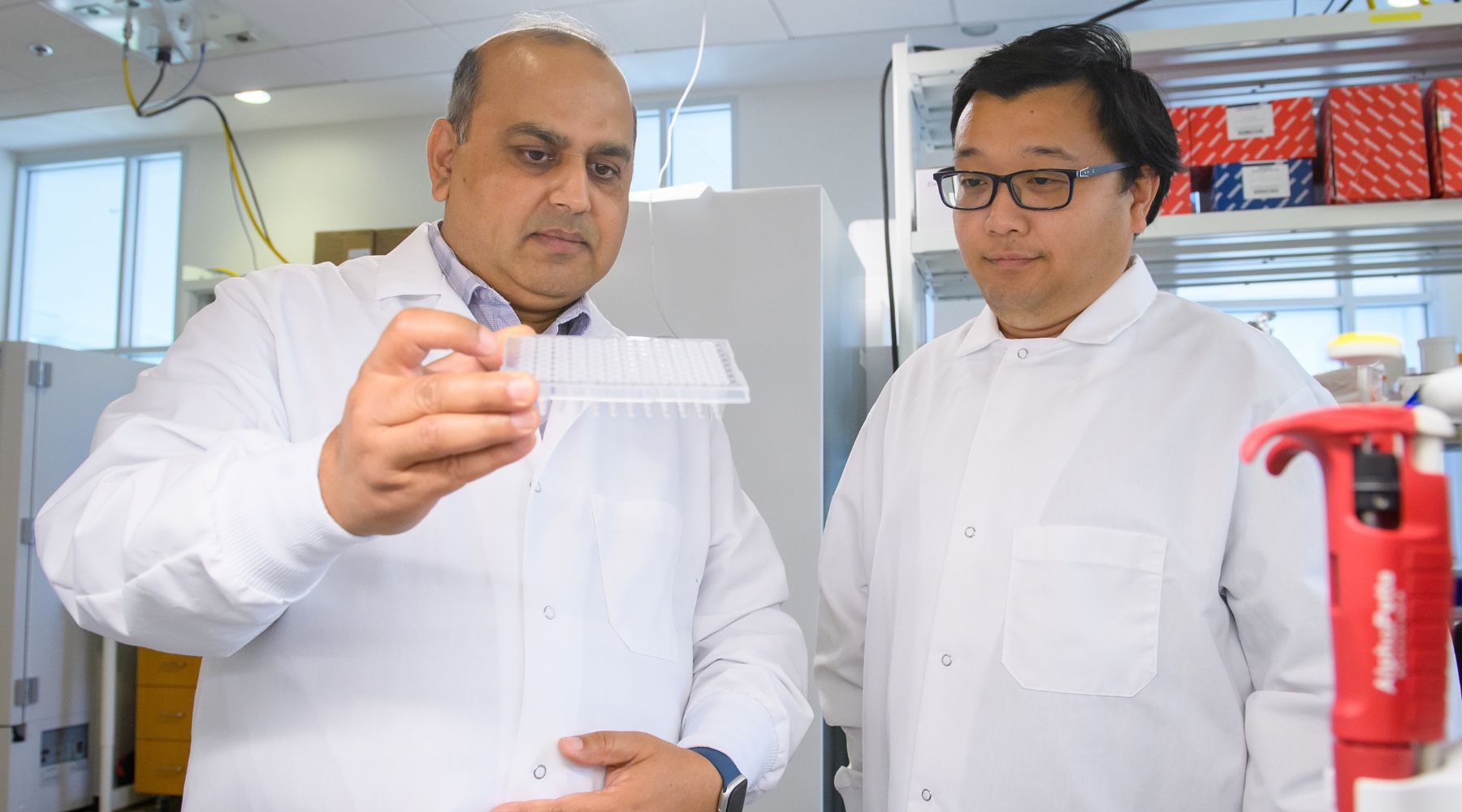
“For families waiting for a diagnosis, every day counts,” said Dr. Gaurav Varshney, who led the research project at OMRF. “Our new tools allow us to test whether a specific genetic mutation causes disease in a matter of weeks rather than months. This means we can give families answers faster and help doctors make more informed treatment decisions.”
The new tools are built on technology called CRISPR, which revolutionized genetics by allowing scientists to make precise changes to DNA. The new gene editors use an engineered protein that can precisely change individual pieces of DNA with high accuracy and minimal side effects.
Varshney’s lab tested the tools in zebrafish. About 80% of human disease-causing genes have a counterpart gene in the tiny aquatic creatures. The OMRF researchers successfully created zebrafish models of genetic conditions that include a form of hearing loss and a developmental disorder, proving the technology can validate whether specific mutations cause disease.
While the tools were tested in zebrafish, they can be adapted to other research models, Varshney said. And these models can be used to test mutations that physicians identify in patients.
“We’ve essentially created a testing platform that can help resolve diagnostic uncertainty,” said Wei Qin, Ph.D., a scientist in Varshney’s lab who also worked on the project. “When a patient has a genetic variant that might or might not cause their condition, we can now quickly create a model carrying that exact mutation and see whether it produces similar symptoms. This gives doctors and families the evidence they need.”
This new technology will be made available for free to researchers worldwide, said Varshney.
The journal Nature Biomedical Engineering recently published this discovery. Varshney’s research was supported by grant No. R24OD034438 from the Office of Research Infrastructure Program of the National Institutes of Health, along with funding by the Presbyterian Health Foundation.
This content is solely the responsibility of the authors and does not necessarily represent the official views of NIH.