Whether you feel a bit like Ebenezer Scrooge this holiday season or you crave the good feelings that accompany generosity, the cause may stem, at least in part, from your hormones and the chemicals in your brain.
That’s the assessment of a pair of Oklahoma Medical Research Foundation scientists.
Research has linked stinginess to testosterone. It’s a predominantly male hormone, which may explain the extreme miserliness of Scrooge, whose name remains synonymous with greed nearly 200 years after the publication of Charles Dickens’ “A Christmas Carol.”
In a 2009 study, researchers applied either a testosterone cream or a placebo cream to male college student volunteers. They then tested the generosity of both groups by giving each student $10 and having them split the money with another participant however they wished.
The results: Those on the testosterone cream gave 27% less to their fellow participants than those on the placebo cream. A more potent variant of testosterone showed even more dramatic effects, as those with the highest levels in their bloodstream gave their study partner an average of 55 cents, compared to $3.65 given by those with the lowest amounts.
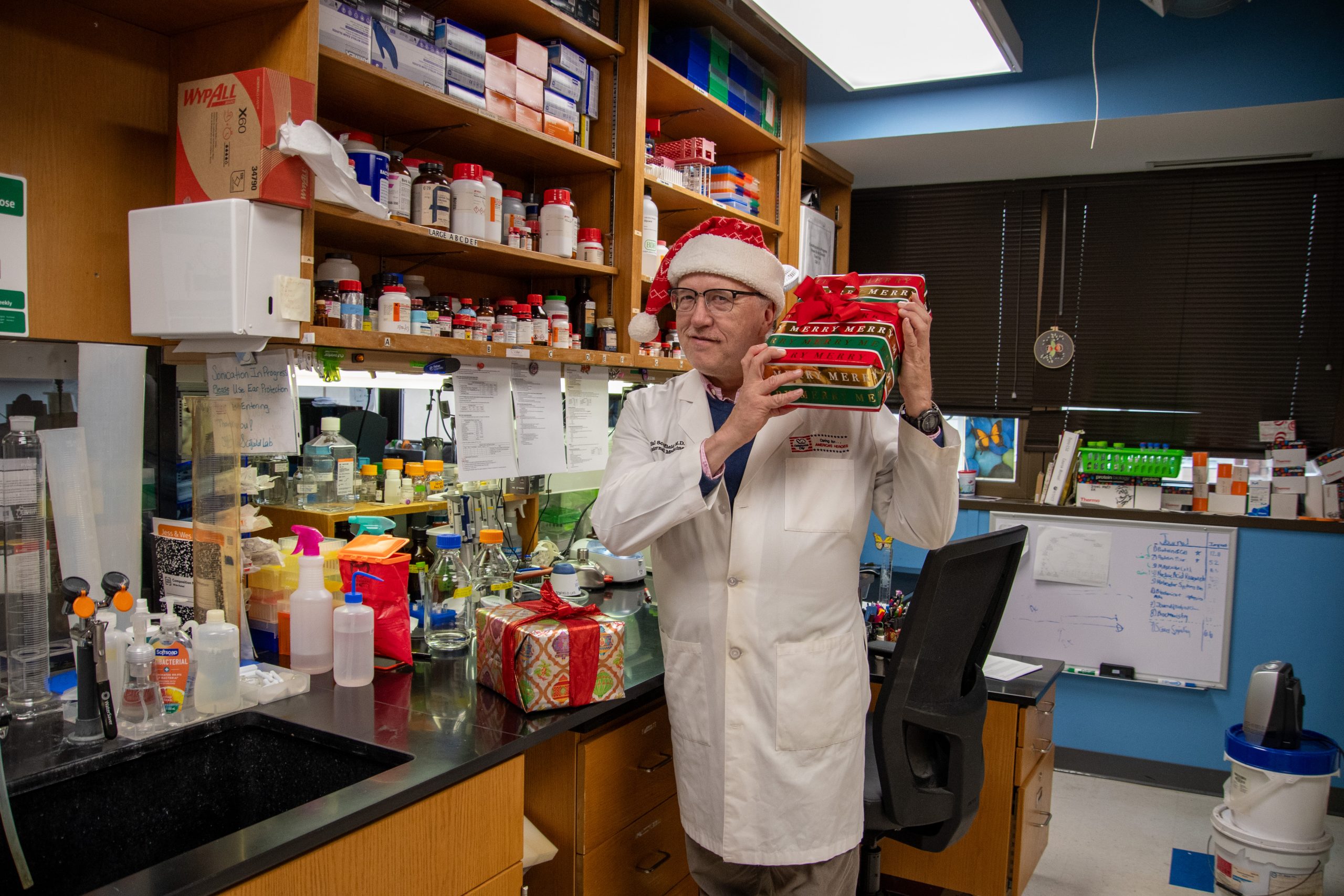
“The subjects were randomized and were ‘blind’ to whether they were using the real hormone cream or the placebo,” said OMRF physician-scientist Hal Scofield, M.D. “In scientific research, that’s the gold standard for assuring reliable results.”
Another factor in Scrooge’s stinginess could have been dopamine, which acts as a neurotransmitter for the brain’s reward system, said Mike Beckstead, Ph.D., who holds the Hille Family Foundation Chair in Neurodegenerative Disease Research at OMRF.
“Dopamine is more designed to signal immediate gratification, while the rewards of generosity are more delayed,” said Beckstead, who studies the brain chemical in his lab at OMRF. “Dopamine would teach you that if you spent $100 on a gift for somebody, that’s a net negative to you, because the immediate act of giving is that you’re $100 poorer.”
Conversely, Beckstead said, high levels of two other brain chemicals, serotonin and oxytocin, would lead someone toward generosity.
“Serotonin promotes mood and well-being, while oxytocin is often called the brain’s love chemical. It’s focused on trust and social connection and intimacy,” Beckstead said.
This isn’t true only in humans. Several studies have found that oxytocin drives mammals like elephants and dogs to show altruism toward distressed animals of the same species. Earlier this year, scientists found that mice do the same thing.
“Those stories you hear about dolphins protecting swimmers from sharks – that’s altruism,” Beckstead said. “And the main brain chemicals involved with that are serotonin and oxytocin.”
Both OMRF scientists cautioned that neither high levels of testosterone and dopamine, nor low levels of the altruistic brain chemicals, doom anyone to a lifetime of stinginess.
“Studies have shown that generosity is both innate and a learned behavior,” Scofield said. “Like Scrooge eventually realized, we seldom regret being generous. The regret usually stems from not learning that lesson earlier in life.”