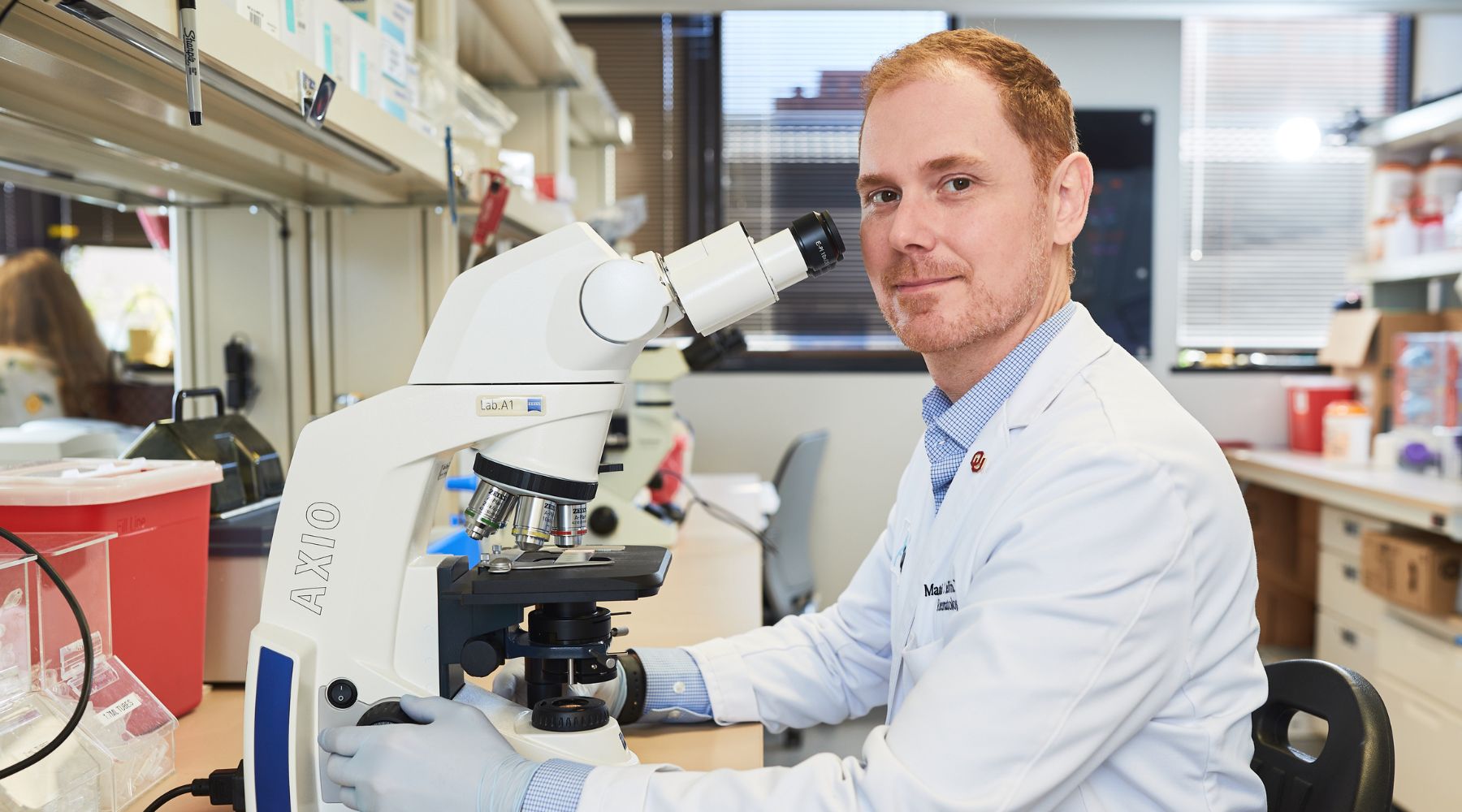
The Oklahoma Medical Research Foundation has received a new $1.7 million National Institutes of Health grant. The award will fund studies aimed at understanding how the body’s immune system changes when a person develops osteoarthritis.
The project may provide clues about who’s at risk of developing the disease and how rapidly it may progress, said OMRF’s Matlock Jeffries, M.D., the lead investigator on the grant.
The National Institute of Arthritis and Musculoskeletal and Skin Diseases, part of the NIH, awarded the three-year grant before the federal government shut down over an ongoing funding dispute.
Jeffries, a rheumatologist and director of OMRF’s Arthritis Research Center, will analyze existing blood samples from OMRF clinic patients and from the Osteoarthritis Initiative, an NIH-sponsored project focused on studying how the disease progresses over many years.
Osteoarthritis, or OA, is both the most common form of arthritis and the leading cause of disability in this country, affecting more than half of all Americans over age 65. The only definitive treatment for knee OA, joint replacement, is the largest Medicare expense.
“There are generally three types of OA,” Jeffries said. “There’s the kind that follows some sort of joint trauma, like from a car wreck or athletic injury, the kind that accompanies obesity from extra stress put on weight-bearing joints, and finally the type that is part of the aging process.”
OA involves an overactive immune system, resulting in chronic inflammation and making joints hurt and lose function over time. In most cases, the disease is active several years before damage appears on X-rays, Jeffries said.
“We want to understand how the immune system in people with OA differs from that of healthy controls,” Jeffries said. “Beyond that, we hope to learn how the immune system changes over time after the onset of OA.”
Clinical trials are ongoing for potential OA treatments, but these tend to focus only on a single affected joint. The problem with that approach, Jeffries said, is that OA seldom is confined to a single joint.
“While one joint may experience the most significant inflammation, people with OA tend to have it in other joints, too,” he said. “So, if we can better understand what’s going on within the overall immune system, it might lead us to a treatment that slows progression throughout the body.”
OA varies, not only from person to person, but even between joints in the same person, noted Judith James, M.D., Ph.D., OMRF’s executive vice president and chief medical officer.
“That’s why Dr. Jeffries’ work is so important,” said James. “He is developing tools and biomarker sets to help us see whose arthritis is progressing or has the potential to progress quickly toward irreversible damage.”
Jeffries’ new grant is No. 2R01AR076440. Preliminary research leading to this grant was supported by the Presbyterian Health Foundation and the Oklahoma Center for Adult Stem Cell Research, a program of the Tobacco Settlement Endowment Trust.