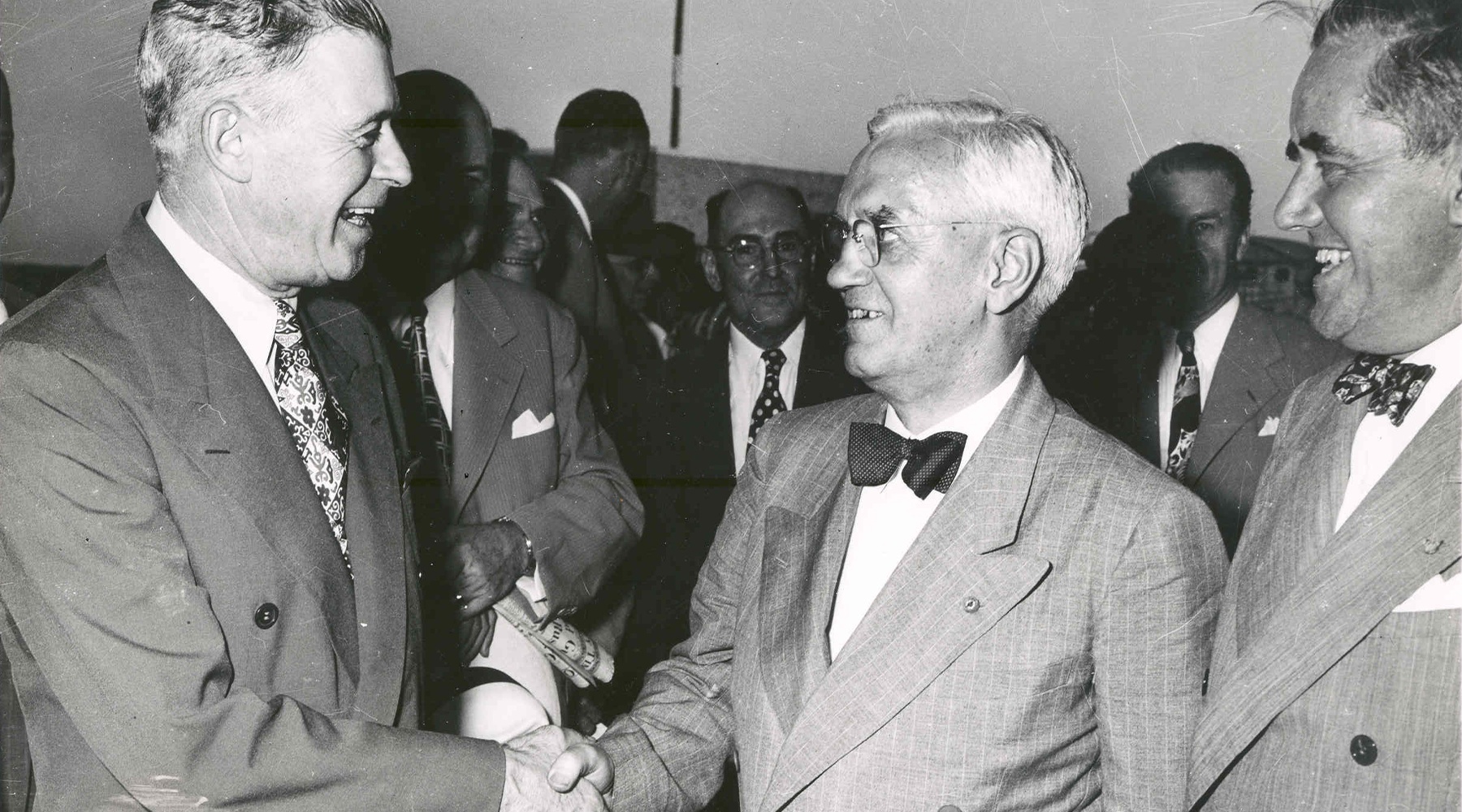
The Fleming Scholar Program was founded in 1956 as a way to give Oklahoma’s high school and college students “hands-on” biomedical research experience. The program is named for Sir Alexander Fleming, the famed British scientist, who discovered penicillin and in 1949 came to Oklahoma City to formally dedicate the Oklahoma Medical Research Foundation’s first building. In the first news release about the program in 1956, the late Dean A. McGee, then Chairman of the Board of Directors’ Executive Committee, expressed the philosophy behind the program:
“We feel that students will greatly benefit from the opportunity of working shoulder-to-shoulder in the laboratories with our scientific personnel. Our scientists feel also that in this way they can make a direct contribution to the solution of the critical manpower shortage in the field of biology and medical research. We are shorthanded in terms of having adequate staff to do the job of expanding our knowledge in the field of human health, and perhaps by this program, we will be helping identify and stimulate the scientists of tomorrow.”
In 1982, the Fleming Scholar Program became a model for a national program funded by the federal government to bring the best and brightest high school and college students into contact with the best and brightest scientific and mathematical minds in government and non-government laboratories.
Today the Fleming Scholar Program remains popular, attracting as many as 100 applicants each year.
Eligibility
To apply for the Fleming Scholar Program, you MUST be:
- An Oklahoma resident at the time of high school graduation.
- At least 16 years of age.
- Classified as a high school senior or college freshman, sophomore or junior at the time of application.
- A United States citizen or permanent resident or have unrestricted employment authorization in accordance with applicable Immigration and Naturalization Service regulations (example: J-2 with Employment Authorization Document). Applicants with an H-4 visa are not eligible to apply.
- Willing and able to commit to the program’s entire eight-week time frame, which begins the first Sunday or Monday following Memorial Day.
Scholars are selected based on aptitude and interest in science and math, academic standing, as well as essays and recommendation letters written as part of the application process.
Instructions:
- Applicants must submit all of the following by the February 1 deadline:
- Application Form — Access and complete the Laboratory Application via the online applicant tracking system.
- Essay — Attach your long essay response via the online application system when prompted to add “Resume/Curriculum Vitae”. Your essay should describe why you wish to participate in biomedical research for eight weeks at OMRF. We are especially interested in how well you formulate your ideas and express them. You might want to explain how an interest, experience, or project led to your better understanding of a scientific principle or how you displayed critical analysis and creativity in solving a problem. Please do NOT exceed two pages.
- Transcripts — Attach your unofficial transcript(s) via the online application system when prompted to add “Transcript 1, 2 and/or 3”. College students must submit both high school and college transcripts.
- Recommendation Forms and Letters — References must send a recommendation letter on their organization’s letterhead along with a completed Recommendation Form. Send a minimum of two and maximum of three recommendation letters with accompanying forms directly to the Fleming Scholar Selection Committee, via e-mail FlemingScholars@omrf.org. or mail: OMRF Fleming Scholar Program, 825 NE 13th Street, Oklahoma City, OK 73104.
- It is preferred that the entire application packet be submitted electronically however if not possible, items other than the application form may be submitted via any of the following avenues:
- Scan and e-mail: FlemingScholars@omrf.org.
- Mail or deliver to: OMRF Fleming Scholar Program, 825 NE 13th Street, Oklahoma City, OK 73104.
- Do not use staples for any mailed or delivered material.
- Extra materials, such as additional recommendation letters or resumes, will not be accepted.
- Incomplete application packets or materials received later than February 1 will be disqualified.
- The application process is considered complete once the applicant receives a confirmation number and upon submission of at least two reference letters/forms.
- Contact Courtney Stevens (405-271-7434, 800-522-0211 or courtney-stevens@omrf.org) with any questions.
Deadline
All complete application packets must be submitted and/or postmarked by February 1.
Application and Recommendation Form
Access the Laboratory Application
Download the Recommendation Form
Program Dates
The program runs for eight weeks beginning the first Sunday or Monday after Memorial Day. Because the program is so rigorous and intense, scholars must commit to the entire timeframe.
View Flyer
HOW are Fleming Scholars selected?
Each year a committee of OMRF employees, mostly scientists, selects the Fleming Scholars. All complete applications received by the appointed deadline are reviewed by selection committee members. After this initial review, the committee meets to select the top 25 applicants to interview. Following the interviews, the committee selects as many scholars as there are mentors and funding available. Three or four alternates are named as well.
WHEN are Fleming Scholar selection results available?
The 25 semi-finalists, as well as those not selected, are notified in late February or early March. Then, interviews occur in early to mid-March. Final results are available following the interviews.
WHAT do Fleming Scholars do?
Fleming scholars work in state-of-the-art biomedical research laboratories on individual projects and are supervised by senior members of the OMRF scientific staff. Every effort is made to assign scholars to laboratories conducting research of particular interest to them. The scholars attend weekly seminars as well as occasional social events as a group (see “WHAT about fun stuff?” below).
On the final day of the program, scholars give formal scientific seminars outlining the findings of their projects. Parents, teachers, OMRF staff and other guests are invited to attend. Each scholar also writes a scientific paper summarizing his/her summer project. Those papers may be published online and are available to download.
WHEN does the program start?
Fleming Scholars work at OMRF for eight weeks typically in the months of June and July. Their first day is the Sunday or Monday after Memorial Day.
WHERE do scholars live?
Housing is provided to eligible scholars. A gated complex located near OMRF is arranged like dormitories, and scholars are assigned in groups of three or four per unit.
WHAT about transportation?
OMRF does not provide transportation to and from work. Group transportation is provided to some social events, but most often, scholars are responsible for their own transportation.
WHAT about meals?
Breakfast is provided at no cost to all scholars every work day morning in the OMRF Research Café . Otherwise, scholars are responsible for their own meals. Lunches may be purchased in the Research Café at the employee discount, which averages around $6.00 per meal. Evening meals are the responsibility of each scholar, with the exception of the meals provided at social events.
WHAT do scholars wear?
As a safety precaution, scholars should wear long pants and closed-toed shoes to work. Jeans are acceptable, as are athletic shoes. Lab work can be messy so scholars must dress appropriately and avoid wearing torn clothes, dangling jewelry, etc. Lab coats, safety goggles, and any other necessary protective gear will be provided.
DO scholars have to commit to the full eight weeks?
The Fleming Scholar Program is rigorous and intense. Eight weeks is quite a short time to initiate—and complete—a detailed scientific project. In fact, many scholars find it necessary to return to OMRF in the weeks following the program in order to complete their experiments and put the finishing touches on their papers. An absence of even a few days can make it difficult for a scholar to catch up before the program ends. Therefore, scholars are required to commit in advance to attendance for the entire eight weeks of the program.
MAY a person apply again if not selected the first time?
As long as the applicant meets the eligibility requirements for the program, he/she may apply to the program for as many years as desired. So, from senior year (high school) to junior year (college), candidates may conceivably apply once each year. Many scholars have been selected on their second or even third try, so anyone who is unsuccessful the first time is encouraged to apply again.
HOW many times can someone be a Fleming scholar?
Being a Fleming Scholar is a once-in-a-lifetime opportunity. The program was established with the purpose of affording this unique chance to as many gifted, science-minded students as possible.
WHERE do scholars go for help?
The Human Resources Department is available to provide any assistance before, during and after the program. Scholars will also be assigned to mentors or their designees who to support scientific endeavors. Resident Assistants (RAs) are accessible 24 hours a day, 7 days a week at the provided housing. Scholars are expected to maintain the utmost professionalism at all times, as are all OMRF employees. This opportunity is full of fun, but ultimately it is a job.
WHEN do scholars get paid?
Scholars are paid an hourly rate commensurate with their relevant educational level. Paychecks are distributed the last working day of each month.
WHAT about fun stuff?
While the work is challenging and even, on occasion overwhelming, there is still plenty of fun associated with the Fleming Scholar Program. Scholars are invited into the home of OMRF’s President for dinner and socializing. Other group activities are also arranged for the scholars, such as cultural and other social events.
2011 Fleming Scholars
Lukas Cara
Lawton, OK
Sophomore, University of St. Thomas
Christopher Chan
Oklahoma City, OK
Freshman, University of Missouri, Kansas City
James “J.D.” Henneberry
Stillwater, OK
Sophomore, Brown University
Marrett Hild
Edmond, OK
Freshman, University of Oklahoma
Richard “Rick” Krysiak
Stillwater, OK
Junior, University of Oklahoma
Caleb Lareau
Enid, OK
Freshman, University of Tulsa
Jillian Lundie
Claremore, OK
Sophomore, University of Oklahoma
Supreeth Mannava
Edmond, OK
Freshman, Rice University
Fasil Mathews
Oklahoma City, OK
Freshman, University of Pittsburgh
Kristen Mathias
Midwest City, OK
Freshman, University of Chicago
William “Will” Shrauner
Edmond, OK
Senior, Oklahoma State University
Pooja Vijayvargiya
Enid, OK
Sophomore, University of Oklahoma
YuJing Wang
Edmond, OK
Freshman, Washington University
Yixuan “Jack” Wen
Ardmore, OK
Freshman, Amherst College
Presidential Scholars
Emily Cole
Lexington, OK
Senior, Lexington High School
Mubeen Shakir
Oklahoma City, OK
Freshman, University of Oklahoma
John H. Saxon Service Academy Summer Research Program Students
Angela Cacciola
Ridgewood, NJ
Junior, United States Naval Academy
Matthew Ward
Lancaster, CA
Senior, United States Air Force Academy
2010 Fleming Scholars
Toby Bothwell
Oklahoma City
Senior, Westmoore High School
The Effect of Estradiol and Estrogen Receptors α and β on Bone Marrow and Monocyte Derived Dendritic Cells
Caroline Burnett
Oklahoma City
Junior, Southwestern Oklahoma State University
Identification of Regulatory Regions of the Bright Promoter
Bob Cail
Edmond
Freshman, University of Oklahoma
Compartmentalization of eNOS Activation
Peter Clark
Norman
Sophomore, University of Texas at Austin
Paul Gorbsky
Edmond
Sophomore, University of Michigan
Assessing the Familial Correlations of Systemic Lupus Erythematosus Patients
Jasmine Htoon
Edmond
Senior, Oklahoma School of Science and Mathematics
-18 AND KIAA1529 POLYMORPHISMS IN LUPUS AND BEHÇET’S DISEASE
Jennifer James
Edmond
Freshman, Baylor University
The Effect of Epsin on Tumor Angiogenesis
Teresa Le
Oklahoma City
Senior, Westmoore High School
Alexander Mann
Norman
Senior, Norman High School
Dipika Mohan
Broken Arrow
Senior, Oklahoma School of Science and Mathematics
Investigating the Molecular Role of LDOC1, a Novel Cancer-Related Gene
Halee Patel
Oklahoma City
Senior, Oklahoma School of Science and Mathematics
Effects of Oxidized LDL on Protein Expression in Macrophage Derived Foam Cells
Presidential Scholar
Peter Cormier
Rockford, IL
Senior, Carleton College
Calcium Stimulated Glutathionylation of α-Ketoglutarate Dehydrogenase: Fine-Tuning a Protective Antioxidant Response
John H. Saxon Service Academy Summer Research Program Students
Max Barnes
Hayward, WI
Senior, United States Air Force Academy
David Hoang
Oklahoma City, OK
Junior, United States Naval Academy
2009 Fleming Scholars
Travis Eugene Chapman
Elizabeth Warren Blankenship Scholar
Moore, Oklahoma
Sophomore, Baylor University; Waco, Texas
Kristin Joy Colman
Merrick Foundation Scholar
Shawnee, Oklahoma
Junior, Cedarville University; Cedarville, Ohio
Destry James Elms
Putnam City Schools Scholar
Boise City, Oklahoma
Freshman, Oklahoma City University; Oklahoma City, Oklahoma
D. Frank Han
Kirkpatrick Family Fund Scholar
Edmond, Oklahoma
Senior, Oklahoma School of Science & Mathematics; Oklahoma City, Oklahoma
Jacob William Keeling
Madalynne Peel Foundation Scholar
Enid, Oklahoma
Freshman, Oklahoma State University; Stillwater, Oklahoma
Collin Lyle Kent
Richard K. & Ruth S. Lane Memorial Trust Scholar
Tulsa, Oklahoma
Sophomore, Duke University; Durham, North Carolina
Ganga S. Moorthy
Sarkeys Foundation Scholar
Alva, Oklahoma
Freshman, University of Oklahoma; Norman, Oklahoma
Sean Anthony Olsen
McCasland Foundation Scholar
Chickasha, Oklahoma
Freshman, Redlands Community College; El Reno, Oklahoma
Melissa Noel Peters
Anadarko-Kerr McGee Foundation Scholar
Geary, Oklahoma
Senior, Geary High School; Geary, Oklahoma
Alim Faridali Ramji
Frontiers of Science Foundation Scholar
Oklahoma City, Oklahoma
Senior, Oklahoma School of Science & Math; Oklahoma City, Oklahoma
Maria L. Vera
Puterbaugh Foundation Scholar
Tulsa, Oklahoma
Junior, Oklahoma State University; Stillwater, Oklahoma
Ye Margaret Wang
Robert Glenn Rapp Foundation Scholar
Stillwater, Oklahoma
Senior, Oklahoma School of Science & Math; Oklahoma City, Oklahoma
2009 Presidential Scholars
Edison I. Abeyta
Dr. John H. Saxon III Military Service Academy Scholar
El Paso, Texas
Junior, United States Air Force Academy; USAFA, Colorado
Paul David Crapo
Presidential Scholar
Idaho Falls, Idaho
Sophomore, University of Texas at Austin; Austin, Texas