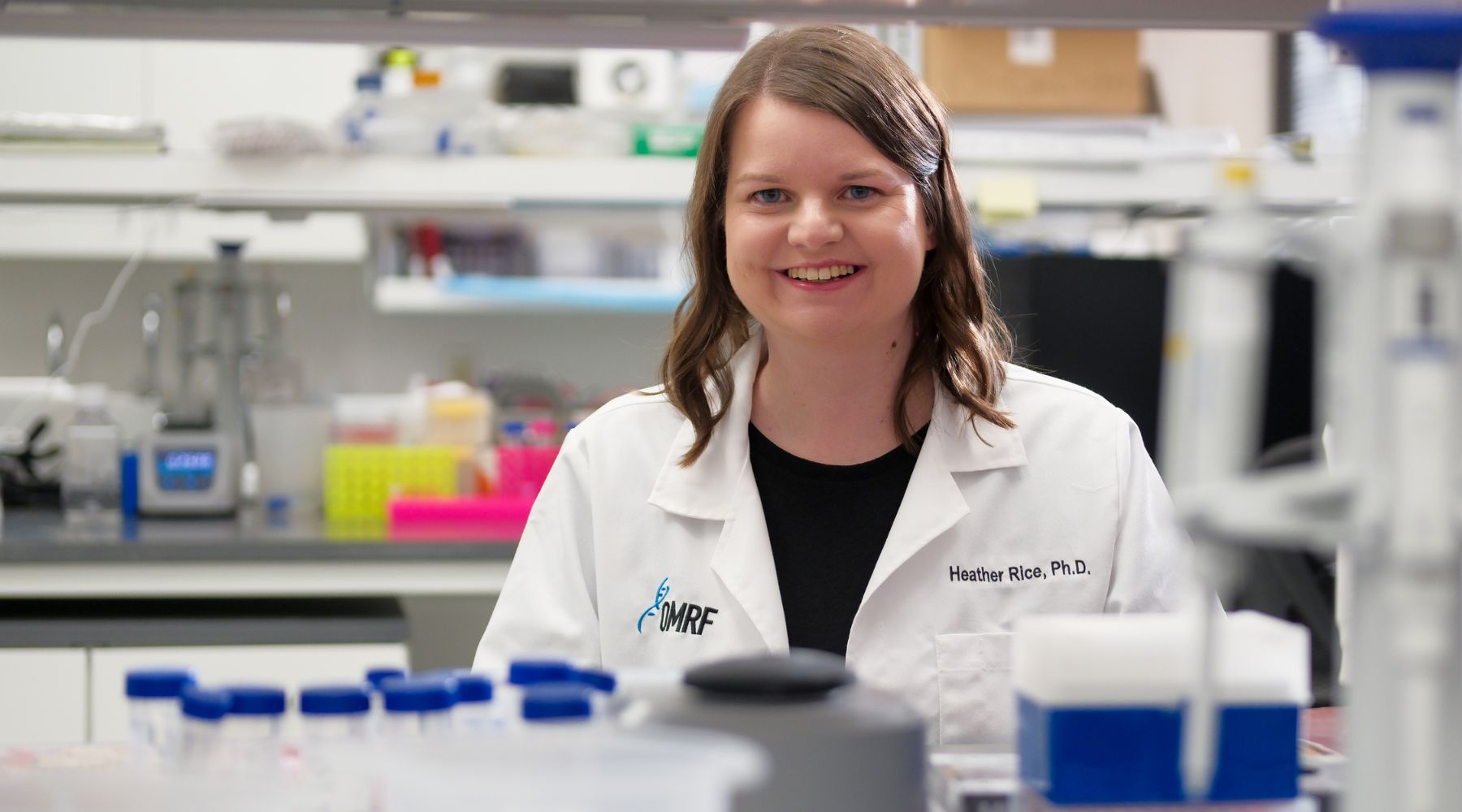
Forgetting dates or recently acquired information is the hallmark sign of early Alzheimer’s. New research by Oklahoma Medical Research Foundation scientists suggests a way to protect the brain from this forgetfulness.
OMRF scientist Heather Rice, Ph.D., studies molecules in the brain called amyloid precursor proteins. Faulty breakdown of these proteins creates plaques that are thought to damage neurons and cause cognitive decline as Alzheimer’s progresses.
“But we have found that these proteins also have beneficial functions,” Rice said. “With this study, we wanted to explore whether those helpful functions might lead to a new treatment avenue for Alzheimer’s.”
Rice collaborated with Boston University neuroscientist Michael Hasselmo, Ph.D., on the study. Hasselmo has developed a model linking excessive brain activity to the development of Alzheimer’s disease, and Rice’s research suggests a potential therapy that could reduce this overactivation.
Along with Dylan Barber, a graduate student in Rice’s OMRF lab, Rice and Hasselmo tested a new idea: that one fragment of the amyloid precursor protein might prevent the uncontrolled growth of brain connections by attaching to a receptor on brain cells.
Using computer simulations, the scientists found that this fragment indeed helped keep memory connections stable by stopping the runaway growth.
Alzheimer’s is the most common form of dementia, affecting nearly 7 million Americans. There currently are no drugs to cure it, but the U.S. Food and Drug Administration has approved treatments for symptoms, including dementia.
Early clinical trials involving work by other researchers have shown promise for a drug cocktail including the muscle relaxant baclofen, which targets the same brain receptors Rice and Hasselmo modeled. “Our study found that the fragment of amyloid precursor protein we tested was more effective at stabilizing memory than baclofen,” Rice said.
While Rice cautioned that her lab’s discovery is a prediction based on computer models, she said it lays the groundwork for further experiments.
“Similar strategies are already being used successfully in new treatments for schizophrenia, and those same drugs could potentially help people with Alzheimer’s as well,” said Hasselmo.
This discovery was published in Alzheimer’s & Dementia, the journal of the Alzheimer’s Association. The study was supported by grant No. R35 GM142726 from the National Institute of General Medical Sciences, part of the National Institutes of Health.