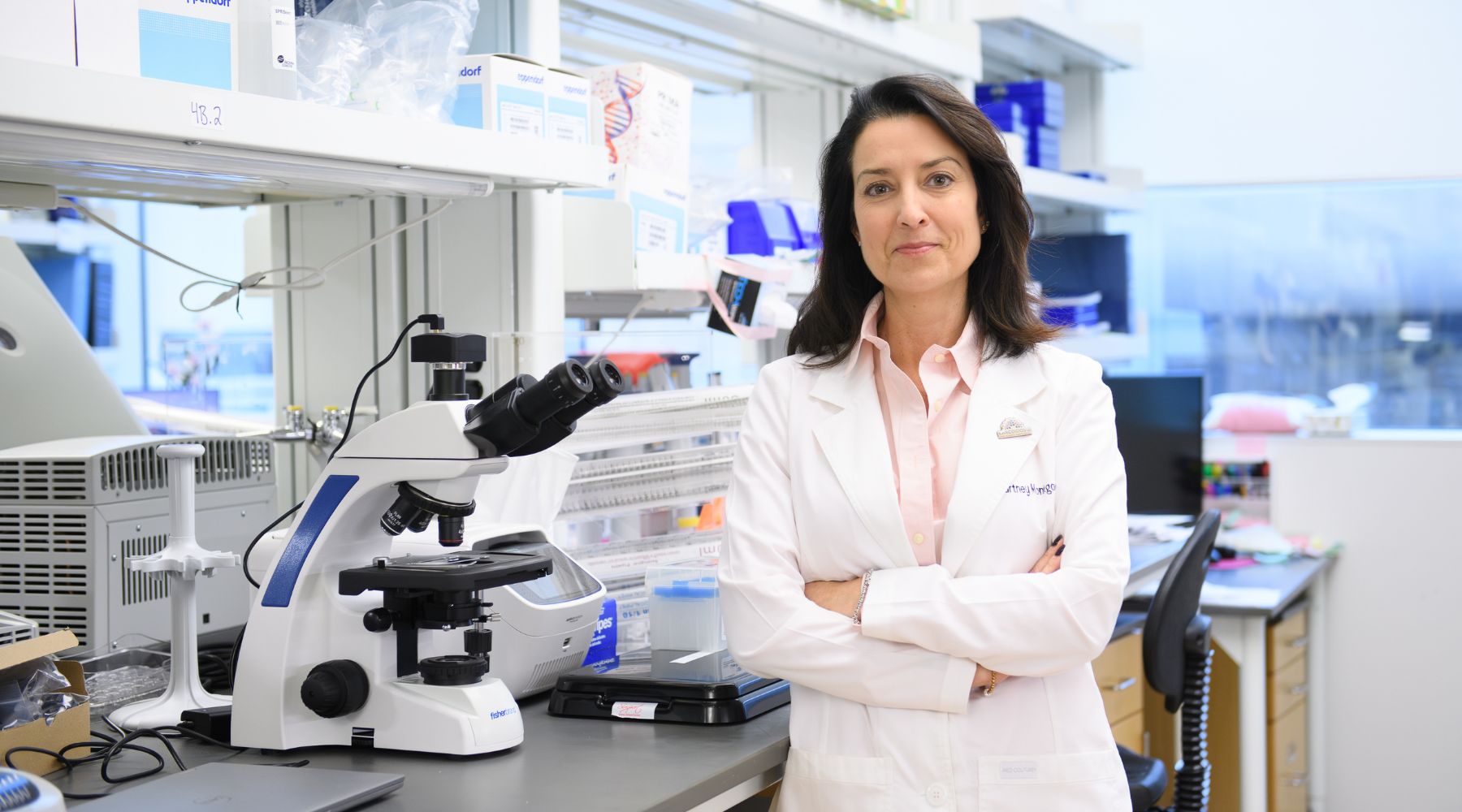
The National Institutes of Health has awarded the Oklahoma Medical Research Foundation a four-year grant aimed at helping more easily diagnose and predict the progression of sarcoidosis, a disease of the immune system.
With the $3 million grant, Courtney Montgomery, Ph.D., also hopes to better understand the disorder’s genetic drivers.
Sarcoidosis develops when groups of immune cells form lumps, called granulomas, in various organs, most often the lungs. Symptoms can include fatigue, shortness of breath, chest pain and a chronic cough, but severe cases can lead to brain or heart damage and can be fatal. The disease is estimated to affect up to 200,000 Americans, about two-thirds of whom are of African descent.
“Currently there’s no definitive test, and there are no biomarkers that would tell us that one person will have a mild disease and another will have severe symptoms,” Montgomery said. “Through this study, we hope to address the multiple layers of severity so that treatment isn’t such a guessing game.”
Montgomery’s lab previously found that the disease manifests differently in people of African descent than in those of European descent. For this study, she will examine blood samples of nearly 3,000 people with sarcoidosis – evenly divided between both ancestries – plus hundreds of healthy people and those diagnosed with other diseases.
“We know that you’re likely to have a less severe disease if the onset begins earlier in life or if you’re of European ancestry,” Montgomery said. “This study should help us move beyond those sorts of basic, generalized groupings.”
Although her lab has a large collection of blood samples for sarcoidosis studies, she is seeking new study participants. For more information, visit omrf.org/sarcoidosis.
“Even with the knowledge gains made in recent decades by researchers like Dr. Montgomery, sarcoidosis often is misdiagnosed because of its complex, variable nature,” said physician-scientist Patrick Gaffney, M.D., who chairs OMRF’s Genes & Human Disease Research Program. “Her new studies could very well result in a diagnostic test, which would be a huge advancement.”
Montgomery’s grant, R01HL175157-01A1, was awarded by the National Heart, Lung, and Blood Institute, part of the NIH.