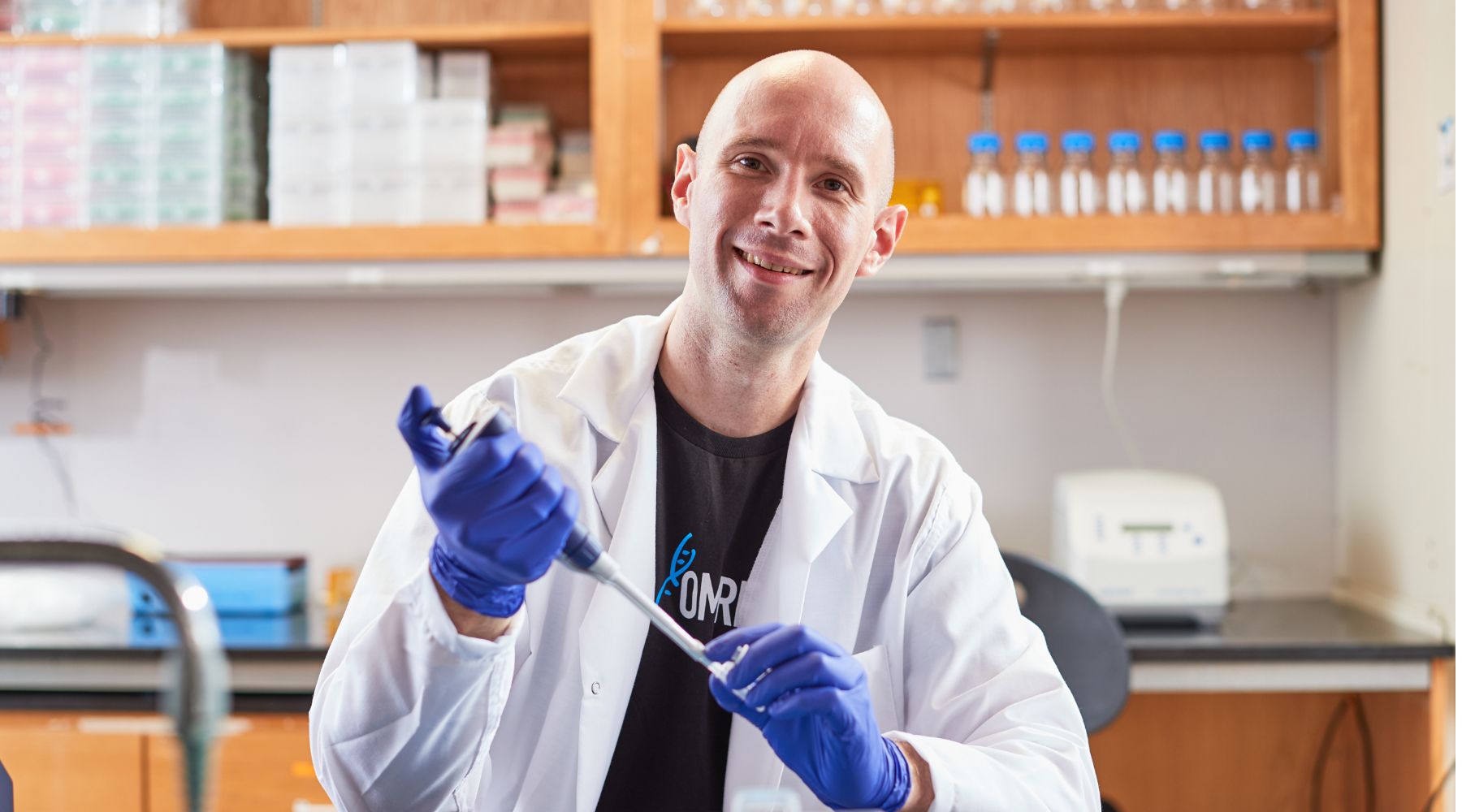
The National Institutes of Health has awarded the Oklahoma Medical Research Foundation a five-year grant for studies aimed at better understanding DNA’s so-called “traffic signals.”
Two recurring DNA processes, transcription and replication, are critical for cells to grow and function properly. Errors in these processes can lead to genetic diseases, cancers and birth defects.
“Every so often transcription and replication collide, and over time these collisions can damage the DNA and pave the way for cancer,” said OMRF’s Rafal Donczew, Ph.D., the principal investigator on the new grant. “That’s why it’s pivotal for us to better understand how the two processes work together.”
Over the next five years, Donczew will test a hypothesis that a particular group of proteins, known as BET, control both transcription and replication and help prevent collisions.
Replication is the process of creating an identical copy of DNA, ensuring that each new cell receives complete genetic instructions. In transcription, an RNA molecule is created from a DNA template, which allows for gene expression and protein synthesis.
“Think of it like a busy two-way street, with transcription being the eastbound lanes and replication being the westbound lanes,” Donczew said. “Normally traffic flows without problems, but every so often one car turns in front of the other and they crash, which is why we have traffic signals.”
He suspects that BET proteins, in concert with other proteins, act much like traffic signals by orchestrating the flow of genetic information.
“By the end of these studies, we should know much more about the roles of BET proteins,” said Donczew, who joined OMRF in 2022 from Seattle’s Fred Hutchinson Cancer Center.
That knowledge would be significant, he said, as BET proteins have been shown to play a role in cancers of the blood, breasts, ovaries and pancreas.
“The therapeutics developed to target BET for those types of cancer haven’t worked as well as hoped, which tells us we need to better understand the basic science behind these proteins,” Donczew said. “That’s what I hope to accomplish.”
The grant, No. R35GM160259, totals $2.3 million and will run through 2030. It was awarded by the National Institute of General Medical Sciences, part of the NIH. Donczew has received funding support from the Presbyterian Health Foundation, and lab equipment essential to this research was funded by the Oklahoma Center for Adult Stem Cell Research, a program of the Oklahoma Tobacco Settlement Endowment Trust.