

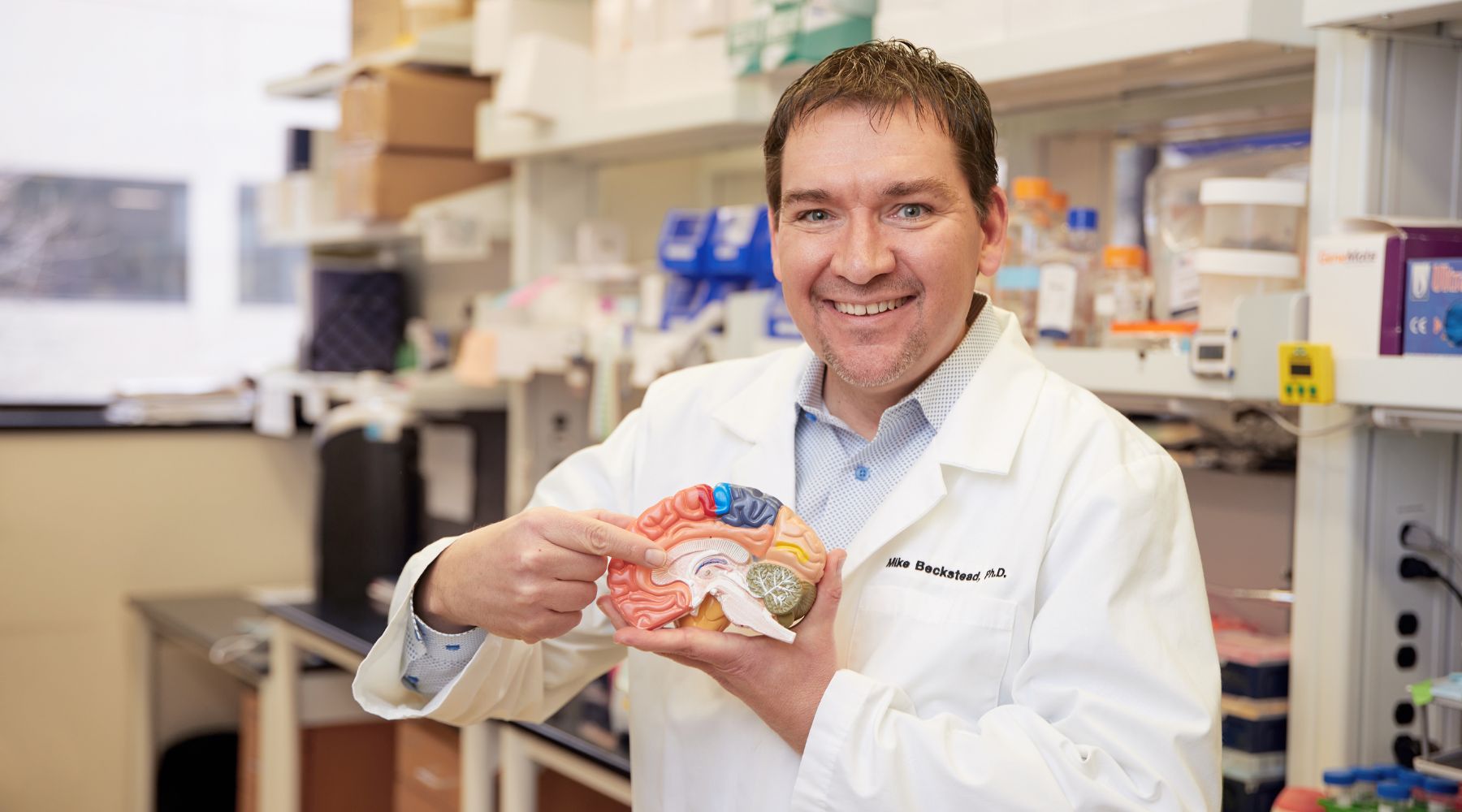
The National Institutes of Health has awarded a five-year grant to an Oklahoma Medical Research Foundation scientist and a collaborator to explore why stress has different effects on male and female brains.
Mike Beckstead, Ph.D., will work with Matthew Wanat, Ph.D., from the University of Texas, San Antonio, on the $3.8 million grant. The research could one day lead to more effective treatments for depression and other mental health disorders.
The new project builds on an intriguing discovery by Wanat: Stress can have opposite effects on learning in male and female rats.

In those experiments, Wanat’s lab found that a brief stressful experience improved male rats’ ability to learn. Specifically, stress increased their recognition that a particular sound signaled an approaching food reward.
But when researchers repeated the experiments in females, the results were more nuanced.
Female rats with lower levels of reproductive hormones responded much like males, showing improved learning after stress. But females with higher levels of circulating hormones showed the opposite response: Their learning ability decreased.
“The reproductive cycle is really influencing how the animals are responding,” Wanat said. In particular, he cited differences in the activation of dopamine, a chemical messenger in the brain that plays an important role in learning, motivation and reward.
The researchers now want to understand how stress interacts with dopamine and reproductive hormones to produce different behavioral responses. Those answers could help explain why males and females can have divergent responses in the same situation.
“For many years, laboratory research relied almost exclusively on male animals,” Beckstead said. “As we’ve started studying females, we’ve discovered that there are important differences in the way males and females respond to stress. We now have a rare opportunity to identify the specific brain circuits responsible for those differences.”
The distinction could have important implications for mental health research, said Beckstead. Stress can contribute to the development of depression, and people with mental health disorders often experience changes in learning, memory and the way they process rewards.
Ultimately, Beckstead and Wanat hope their research will help scientists develop more targeted approaches to treating depression and other psychiatric conditions.
“It’s important that we identify these differences,” Wanat said. “If we’re going to develop better strategies to blunt the harmful effects of stress, we need to understand how the brain responds differently in males and females.”
The grant, No. R01MH142833, was awarded by the National Institute of Mental Health, part of the NIH.
This content is solely the responsibility of the authors and does not necessarily represent the official views of the National Institutes of Health.