

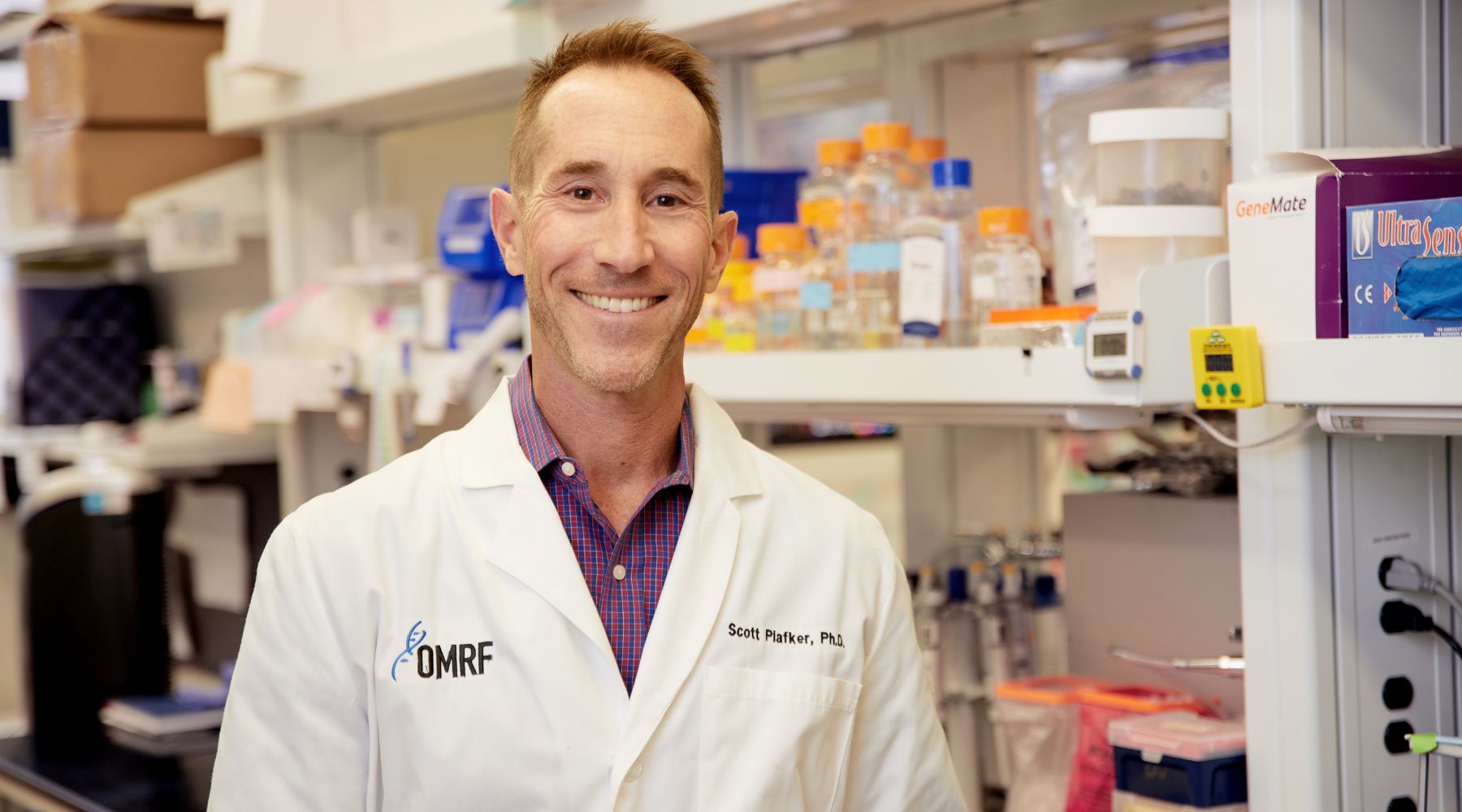
An Oklahoma Medical Research Foundation scientist has received a new National Institutes of Health grant to investigate how dietary changes help protect vision in people with multiple sclerosis.
Scott Plafker, Ph.D., will lead the two-year, $470,000 research project. It focuses on optic neuritis, an inflammatory condition that damages the optic nerve, which carries visual information from the eye to the brain. About 70% of people with MS experience optic neuritis at some point.
Optic neuritis can cause temporary blindness, blurred vision and eye pain. For roughly one in four people who develop MS, a progressive neurodegenerative disease, these eye problems represent the first sign something is wrong.
Current treatment for MS patients with optic neuritis typically relies on high-dose steroids to reduce inflammation. And while steroids can help relieve symptoms, they come with a multitude of side effects and do not address the underlying disease. In addition, repeated use can cause systemic issues like bone loss, high blood pressure and infection.
“Our goal is to find non-steroidal methods to reduce the inflammation before it destroys the optic nerve,” Plafker said.
The new project builds on Plafker’s earlier work involving mice with a condition similar to MS. The OMRF scientist found that mice fed a ketogenic diet – one high in fat, moderate in protein, and low in carbohydrates – developed far less inflammation and experienced significantly milder symptoms.
The new study will probe why this happens. Plafker’s previous work suggests that a keto diet changes the community of bacteria living in the gut, known as the microbiome. These bacteria produce naturally occurring compounds, which then enter the bloodstream and appear to trigger beneficial changes that help reduce inflammation and promote recovery in the optic nerve.
Instead of focusing on the diet itself, the new study tests whether these compounds, called indoles, can produce similar protective benefits on their own.
“If so,” Plafker said, “it may eventually be possible to develop these compounds as nutritional supplements or therapies that are easier for people to use than maintaining a strict ketogenic diet.”
The work is still in its early stages, he cautioned, and more research will be needed before any approach can be evaluated in people with MS.
Still, Gabriel Pardo, M.D., who leads OMRF’s Multiple Sclerosis Center of Excellence and treats thousands of patients with MS, is excited to see where the project leads.
“Many of my patients experience optic neuritis, and the effects can be debilitating,” said Pardo. “Current treatments for acute optic neuritis aren’t ideal. I’m quite hopeful that Dr. Plafker’s research will lead not only to a more natural treatment with fewer side effects, but also to a better understanding of the relationship between the microbiome and inflammation.”
The National Eye Institute, part of the NIH, awarded the grant, No. R21EY037427-01A1.