

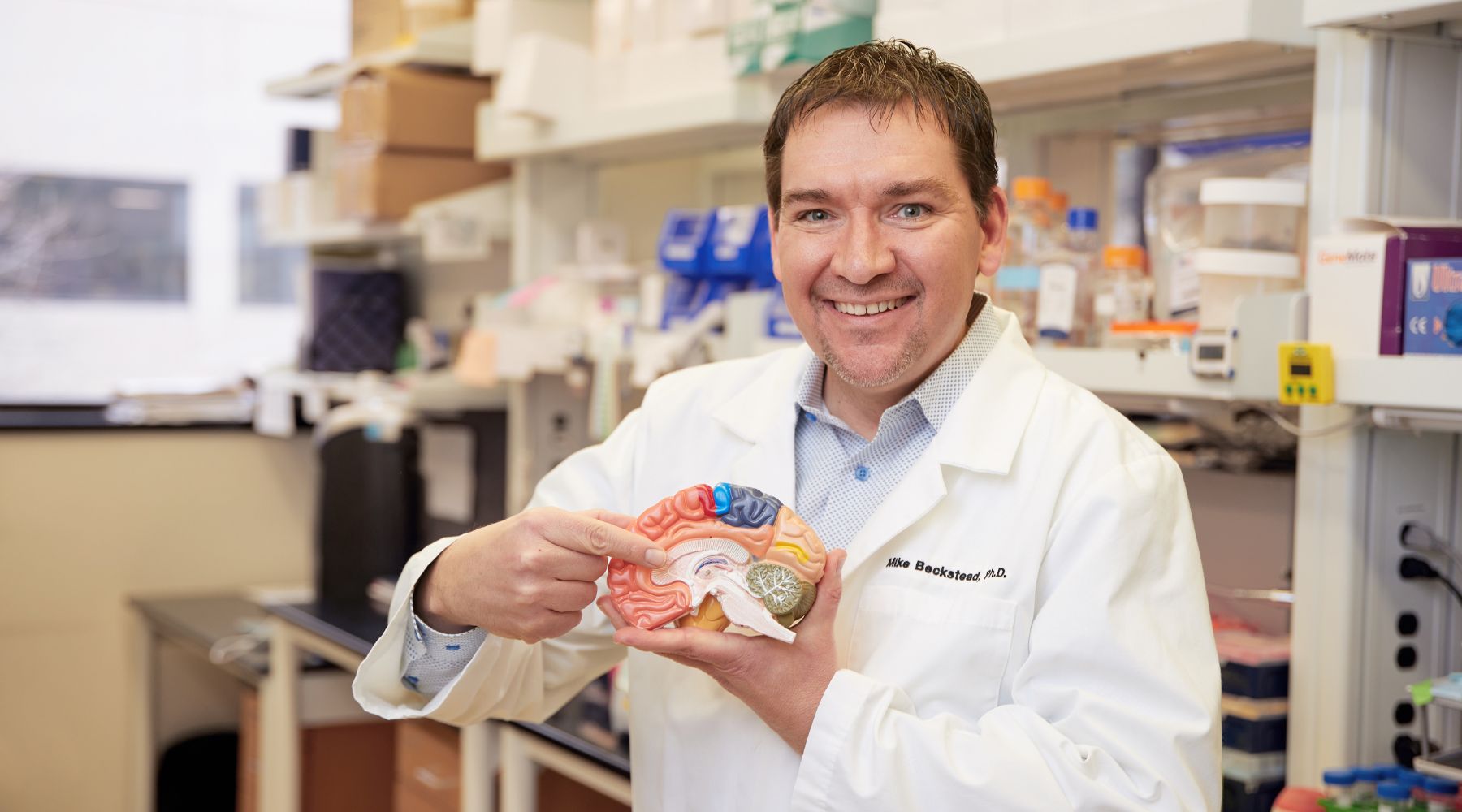
An Oklahoma Medical Research Foundation scientist will oversee experiments aimed at creating a medication to treat methamphetamine and cocaine addiction.
Mike Beckstead, Ph.D., is the principal investigator on a new one-year study funded by the National Institutes of Health. He will collaborate on the $400,000 project with the University of Texas at San Antonio and Astrocyte Pharmaceuticals, a biotechnology company. The grant is funded through an NIH program focused on collaborations between American small businesses with nonprofit research institutions.
“There currently is no FDA-approved drug to treat substance abuse disorder involving meth or cocaine,” said Beckstead, who holds the Hille Family Foundation Chair in Neurodegenerative Disease Research at OMRF. “Instead, healthcare providers often combine behavioral therapy with ‘off-label’ medications to reduce cravings.”
Astrocyte Pharmaceuticals is named for astrocytes, the brain’s most abundant and versatile caretaker cells, which play essential roles in synapse function and the brain’s response to injury and stress. The company has developed an oral drug candidate, called AST-004, which has been found to improve astrocytes’ energy production.
“Drugs like cocaine and meth impair astrocyte function and disrupt their interactions with neurons,” Beckstead said. “We believe that AST-004 can modify behavior, including drug cravings, by enhancing astrocyte metabolism.”
Using mice that have developed addiction through easy access to meth, Beckstead’s lab will induce a 30-day abstinence period. He will then split the mice into two groups: one that receives AST-004 and one that doesn’t. Beckstead then will monitor how quickly and frequently each group returns to meth use.
His longtime collaborator at UTSA, Associate Professor Matthew Wanat, Ph.D., will lead similar experiments involving cocaine use among rats.
Meth and cocaine are highly addictive. A 2021 study by the Centers for Disease Control and Prevention found that among people who admitted using meth during the previous year, 54% met the diagnostic criteria for addiction. In Oklahoma, meth ranks as the most common cause of unintentional overdose deaths, according to the state Health Department.
In addition to this study, AST-004 is being tested in clinical trials for sports-related concussions, traumatic brain injuries and acute strokes.
“We are encouraged by the increasingly broad body of evidence demonstrating AST-004’s effects across a wide range of neurological injuries and disease settings,” said William Korinek, Ph.D., chief executive officer of Astrocyte Pharmaceuticals. “The early results, he said, “are tremendously exciting and continue to expand our view of the therapeutic potential of AST-004.”
The drug abuse treatment study is funded by grant No. R41DA064479-01, awarded by the National Institute on Drug Abuse, part of the NIH.
The content is solely the responsibility of the authors and does not necessarily represent the official views of the NIH.