

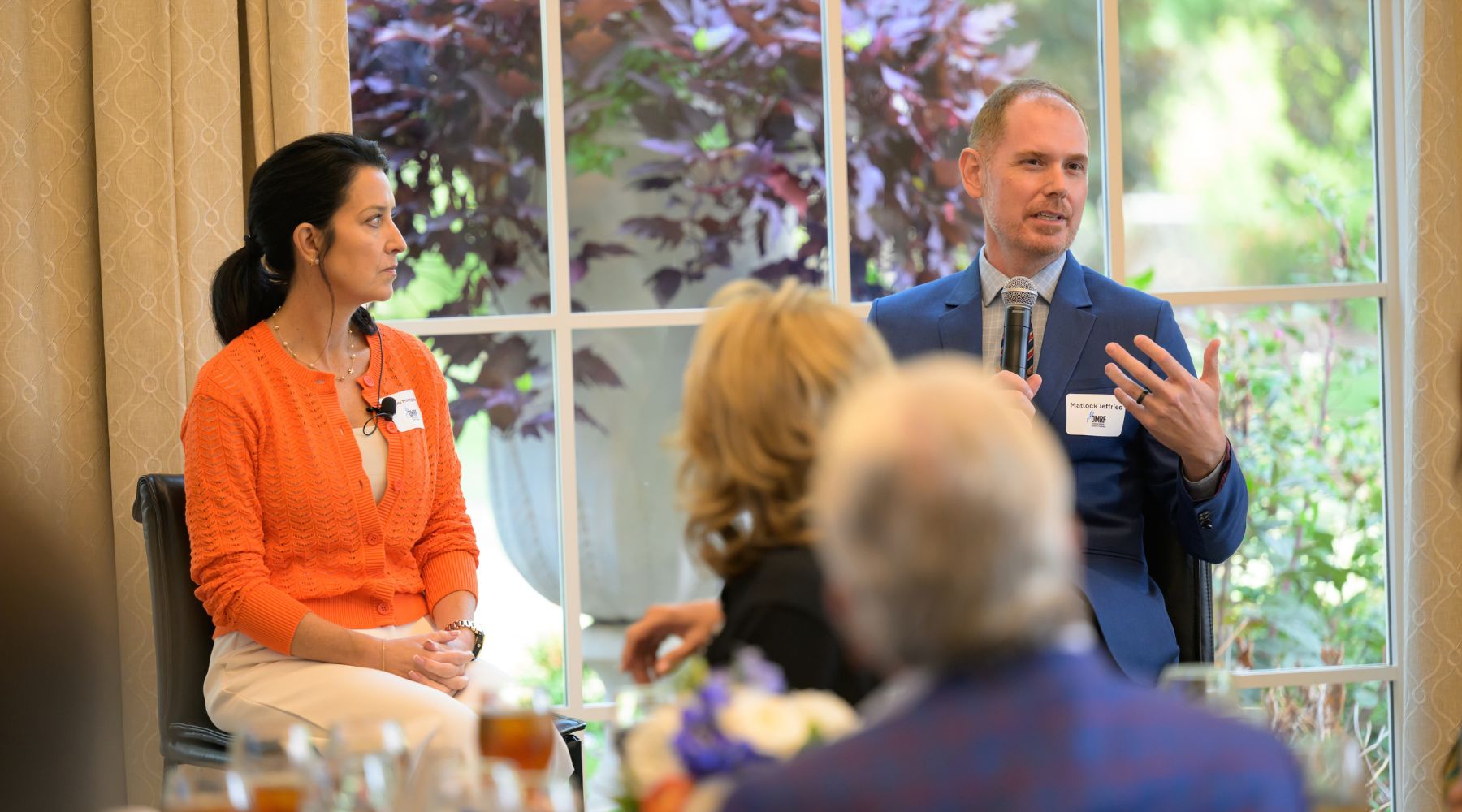
As the world enters a new age of artificial intelligence, two Oklahoma Medical Research Foundation scientists explained to a Stillwater audience Monday how AI is already shaping medical research.
At an event on the Oklahoma State University campus, OMRF’s Courtney Montgomery, Ph.D., and Matlock Jeffries, M.D., talked about how scientists have begun to harness powerful new AI technologies.
Montgomery studies sarcoidosis, a disease that can cause shortness of breath and chest pain – and in severe cases brain and heart damage. She has patent applications pending for what would be the first diagnostic test for the notoriously difficult-to-identify illness.
“AI helped us find a combination of proteins in the blood that can help predict whether a person’s disease will be mild or severe,” Montgomery said. “Without AI, we couldn’t have developed the test.”
Jeffries, a rheumatologist, regularly employs AI to run mathematical and scientific programs. “I also use it as a backstop for lengthy grant applications,” he said. “It reads the text and identifies obvious omissions — and tells me whether I can improve what I’ve written.”
Outside of OMRF, AI-based tools, in the right hands, can save lives, Montgomery said.
One example: The Mayo Clinic created an AI system that correctly flagged 73% of hidden pancreatic cancers long before they otherwise would have been diagnosed. “AI tools like this one have the potential to dramatically increase survival rates,” she said.
The event was hosted by OSU President Jim Hess and First Cowgirl Angela Hess, and by Michael and Anne Greenwood.
“Mike and I always appreciate hearing from OMRF’s scientists, and each time helps us connect more deeply with a foundation that has earned our support,” said Anne Greenwood, who serves on OMRF’s board of directors. “With artificial intelligence being all over the news these days, it was encouraging to hear the scientists describe how OMRF is applying it to advance research.”