

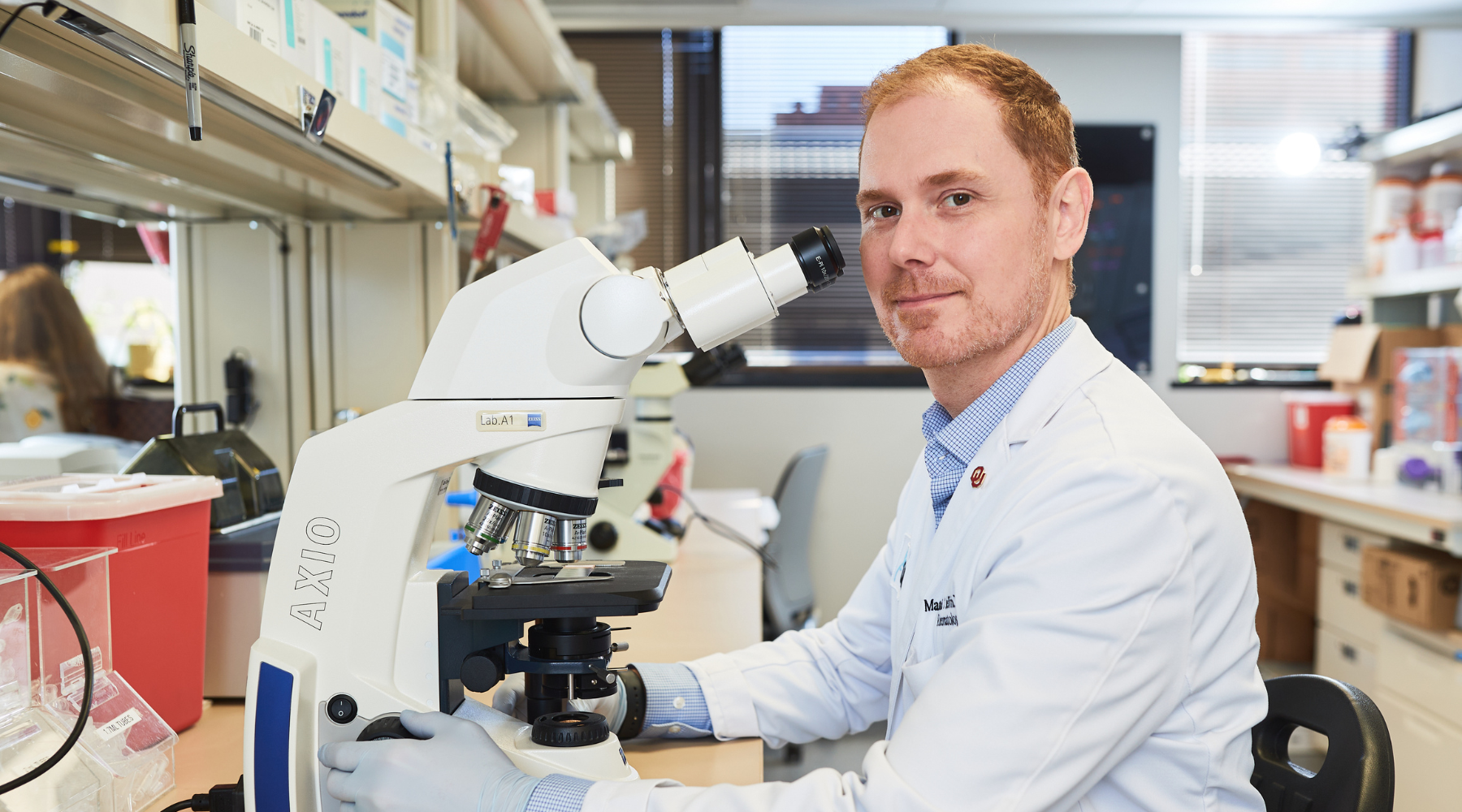
Backed by a new four-year, $1.2 million grant, an Oklahoma Medical Research Foundation physician-scientist will investigate why osteoarthritis develops and progresses differently from person to person.
Matlock Jeffries, M.D., received the grant from U.S. Department of Veterans Affairs. The project builds on previous research that identified long-lasting inflammatory changes in blood cells linked to progression of OA, the most common form of arthritis.
For his new study, Jeffries will analyze blood sample data and medical information from 25,000 veterans. The VA’s Million Veteran Program, one of the world’s largest research databases for health and genetics, will supply the data.
“This gives us access to a much larger and more powerful dataset than we’ve ever had before,” said Jeffries, a rheumatologist who directs OMRF’s Arthritis Research Center. “We can now test whether the biological patterns we discovered in smaller studies hold up across thousands of OA patients.”
OA usually results from cartilage deterioration in the knees, hands, hips or spine. It is significantly more prevalent in veterans due to traumatic injuries sustained in training or combat. Veterans also tend to develop OA at younger ages, meaning they often live with the disease for decades longer than the general population.
Although OA has traditionally been viewed as a “wear-and-tear” condition, scientists increasingly believe that inflammation related to the immune system influences how joints deteriorate.
Jeffries hopes to better understand why some patients experience slow disease progression over decades while others decline within just a few years. He theorizes that OA progression is linked to changes in blood cells that influence how genes are turned on or off.
Jeffries’ lab has already found these characteristic patterns in a previous, smaller study of OA patients. The new study in a much larger set of patients will confirm whether these patterns can help predict who is likely to develop OA, whose disease will worsen quickly, and who may eventually require joint replacement surgery.
A second aspect of Jeffries’ study will use advanced computational methods to estimate the types of immune cells present in patients’ blood samples. By analyzing these patterns, Jeffries hopes to identify specific immune cell populations linked to OA progression.
Currently, no drugs exist that alter the course of OA. The only treatments available focus on managing pain and improving joint function.
Although a handful of OA disease-modifying therapies are now undergoing clinical trials, most target individual joints through injections.
However, most OA patients have several joints affected. A more comprehensive understanding of immune changes in the blood could eventually lead to therapies that treat OA systemically rather than joint by joint, said OMRF Executive Vice President and Chief Medical Officer Judith James, M.D., Ph.D.
“This study shows potential to explain the factors behind OA progression,” James said. “If Dr. Jeffries finds one particular immune cell or pathway driving disease, that could become a new therapeutic target.”
This research is funded by VA grant No. IO1BX007116. It will build on research funded by grant No. R01AR076440 from the National Institute of Arthritis and Musculoskeletal and Skin Diseases, part of the National Institutes of Health.