

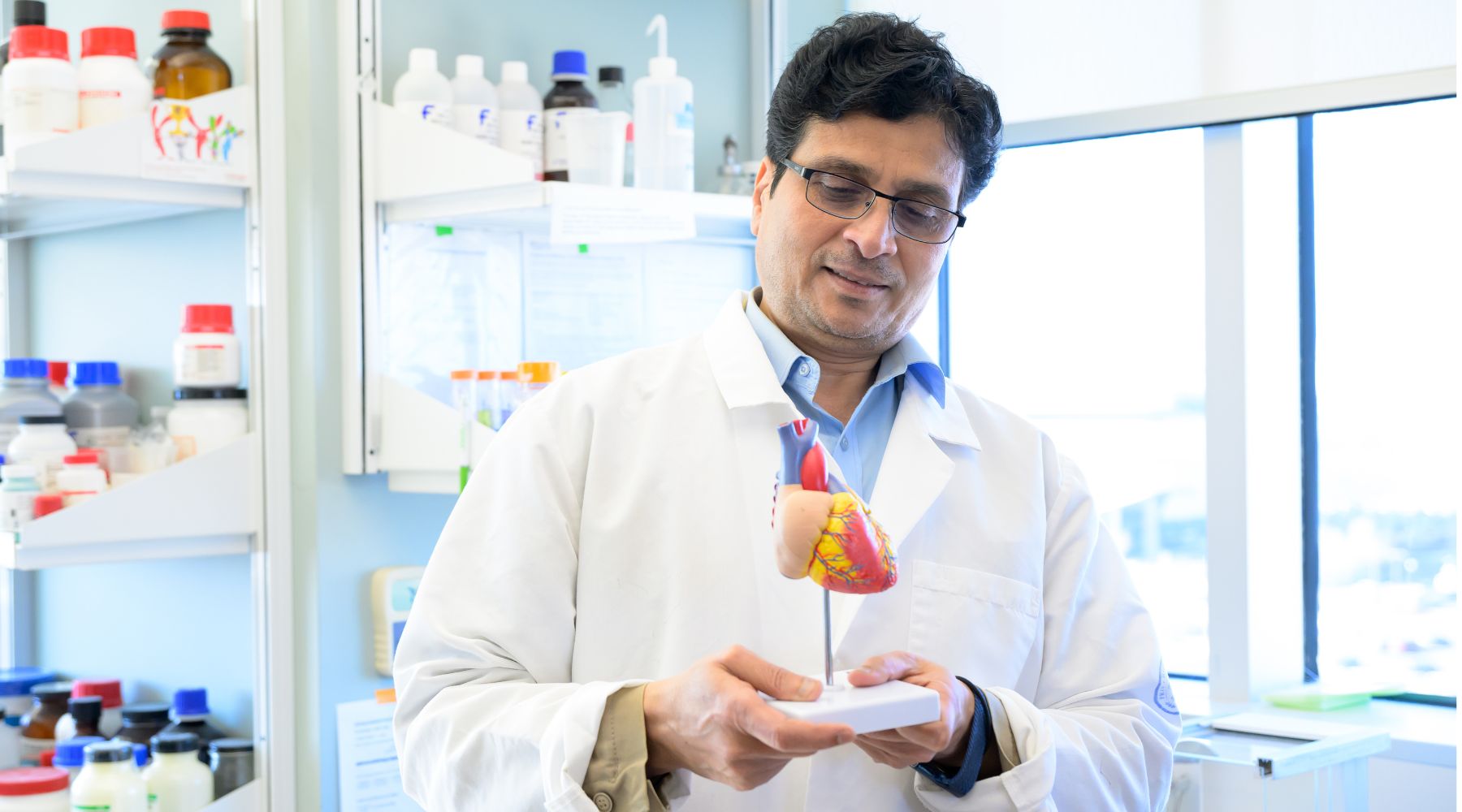
With a new $3.2 million federal grant, an Oklahoma Medical Research Foundation scientist will search for a nonsurgical treatment for a degenerative heart valve disease that primarily affects older adults.
In aortic stenosis, the aortic valve narrows to about one-third its normal size, preventing normal blood flow from the heart to the rest of the body. According to the U.S. Centers for Disease Control and Prevention, it affects 5% of Americans age 65 and older, with disease prevalence increasing to 1 in 8 by age 75.
Currently, the only remedy for aortic stenosis is replacement of the aortic valve. The OMRF lab of Jasim Ahamed, Ph.D., has studied the disease for more than a decade. He has found a major culprit to be a protein called TGF-beta, which becomes activated by high shear stress caused by diseases like aortic stenosis.
The National Institutes of Health has awarded Ahamed a five-year grant to continue investigating the protein’s role in the disease. The grant is a renewal of a previous five-year NIH award.
“Too much TGF-beta can cause the aortic valve to become increasingly narrow and stiff,” Ahamed said. “We hypothesize that aortic stenosis begins a cycle in which TGF-beta is overactivated. As aortic stenosis progresses without intervention, the valve opening continues to shrink, and over time the heart itself becomes scarred and can no longer pump normally. Eventually this leads to heart failure.”
With this new funding, Ahamed will investigate the underlying mechanisms that prompt TGF-beta to become overactive and cause aortic stenosis. Ultimately, his research could pave the way for a drug that would prevent the protein from becoming activated.
Dr. Courtney Griffin, OMRF’s vice president of research, said Ahamed’s research could shift the understanding of aortic stenosis – and how to treat it.
“Dr. Ahamed’s experiments will test whether you can slow or even halt the disease by blocking TGF-beta,” said Griffin. “While it’s still relatively early, his research has game-changing potential.”
The grant, No. R01HL148123-05A1, was awarded by the National Heart, Lung, and Blood Institute, part of the NIH.
The content is solely the responsibility of the authors and does not necessarily represent the official views of the National Institutes of Health.