

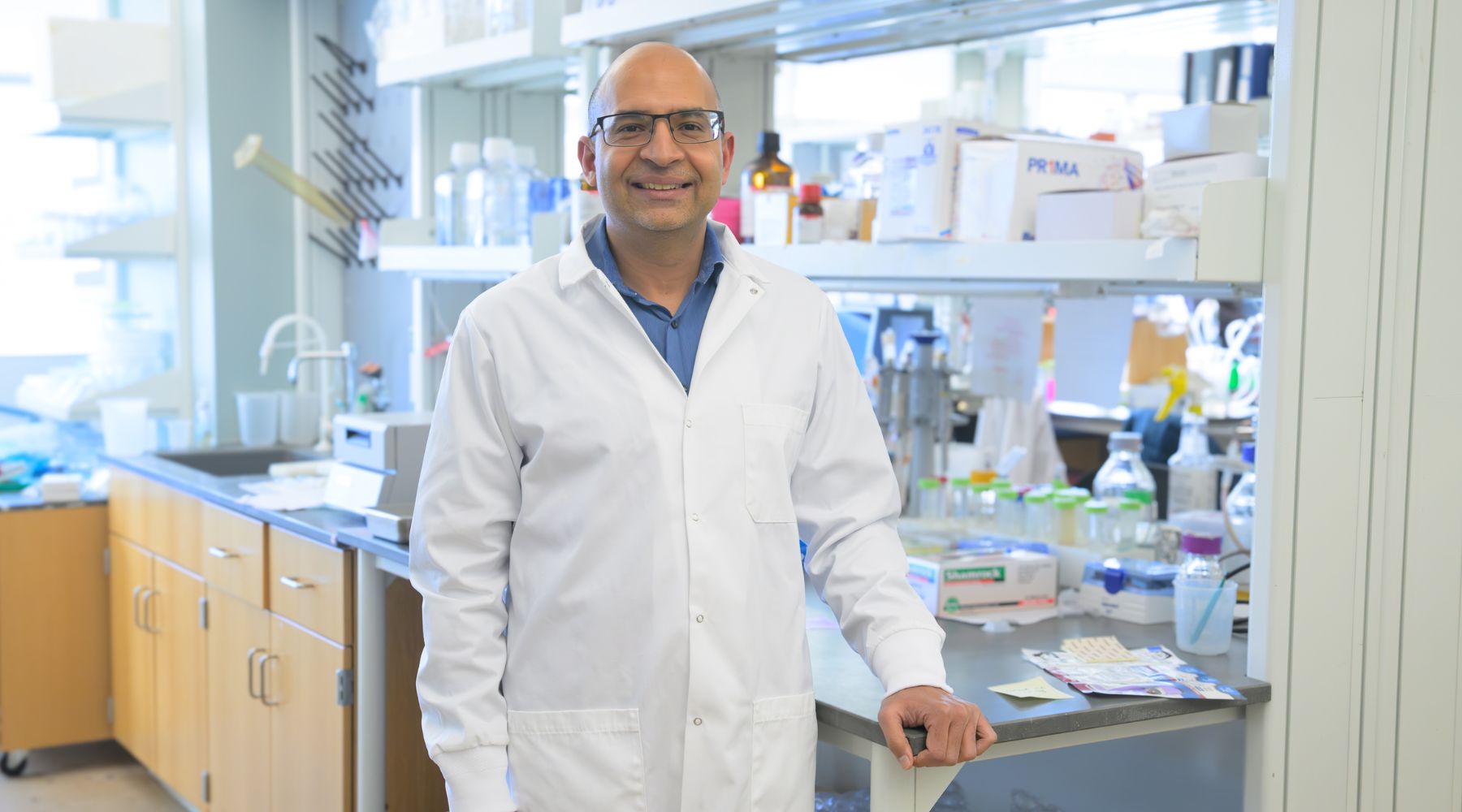
An Oklahoma Medical Research Foundation scientist has been awarded a four-year National Institutes of Health grant for further studies of inflammatory bowel disease.
Sathish Srinivasan, Ph.D., hopes to better understand what role the body’s lymphatic system plays in chronic conditions like Crohn’s and ulcerative colitis. Ultimately, the work could lead to new therapies or ways to prevent the diseases.
Srinivasan’s lab studies lymphatic vessels and valves, which help our bodies move fluids, prevent tissue swelling, fight infections and remove waste. Last year, in tandem with OMRF scientist Xin Geng, Ph.D., Srinivasan discovered that clusters of immune cells form in the intestines of mice whose lymphatic vessels lack a protein called S1PR1.
That discovery, in part, led to the new $2.7 million grant.
“Now we hope to learn the impact of those immune cell clusters,” Srinivasan said. “Are they causing the ferocious and aggressive inflammation that causes Crohn’s to flare up, or could they possibly be preventing that inflammation?”
The answers gained from these experiments could eventually lead to a new drug to treat or even prevent such flares, he said.
Crohn’s disease involves painful and sometimes debilitating inflammation of the digestive tract. According to the Crohn’s and Colitis Foundation, it affects about 1 in every 100 Americans and up to an estimated 8 million people worldwide.
Ulcerative colitis shares similar symptoms with Crohn’s. Each disorder can result in fatigue, anemia, swollen joints and osteoporosis.
Srinivasan hopes to determine what causes the immune cell clusters to form and whether these clusters reduce intestinal inflammation. A third goal is to discover how S1PR1 prevents these clusters from forming.
“Current treatments for inflammatory bowel disease either rely on steroids, which are harmful with long-term use, or else they suppress the immune system, which leaves patients vulnerable to infections,” said OMRF Vice President of Research Courtney Griffin, Ph.D. “With this study, Dr. Srinivasan hopes to uncover new, safer ways to treat it using the body’s own defenses.”
Srinivasan’s grant, No. R01HL185377-01, was awarded by the National Heart, Lung, and Blood Institute, part of the NIH. He previously received funding for critical preliminary research from the Presbyterian Health Foundation and the Oklahoma Center for Adult Stem Cell Research, part of the Tobacco Settlement Endowment Trust.