

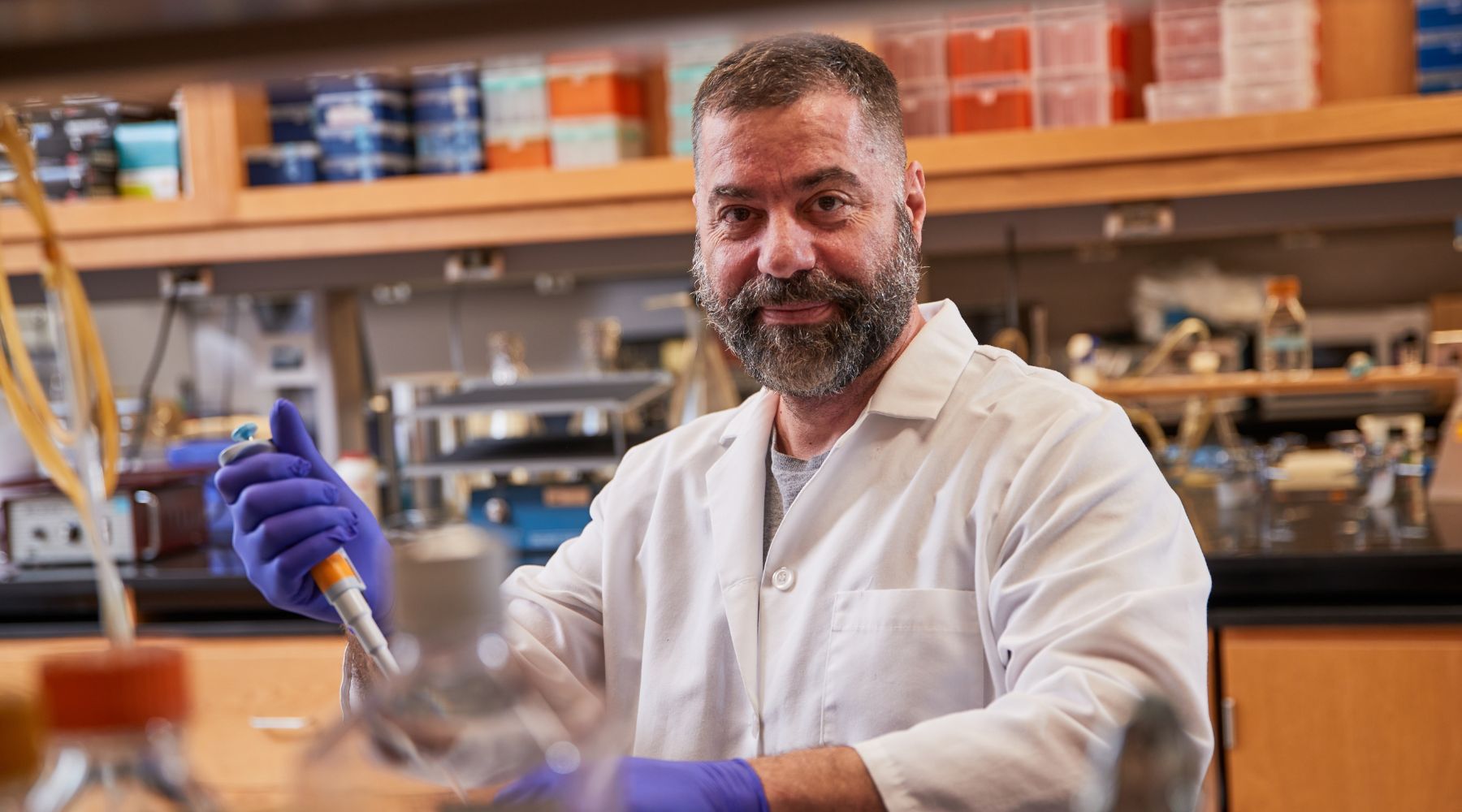
Through studies funded by a new four-year federal grant, an Oklahoma Medical Research Foundation scientist hopes to better understand the cause of errors that lead to miscarriages and genetic conditions like Down syndrome.
The National Institutes of Health awarded a $1.9 million grant to Roberto Pezza, Ph.D., whose lab studies meiosis, a special type of cell division that results in egg and sperm cells.
DNA is compactly organized and packaged into 23 pairs of chromosomes inside the nucleus of these reproductive cells. These chromosomes also contain the instructions for building and running our bodies. During meiosis, matching pairs of chromosomes – one each from the mother and father – must find each other, pair up and eventually separate correctly.
This project will focus on how a group of proteins manages chromosomes to keep the process running smoothly. Mistakes in this process can have serious reproductive consequences, including Down syndrome, which occurs when a baby is born with an extra copy of one chromosome. The most common chromosomal condition in the U.S., Down syndrome occurs in about 1 in every 700 births.
More frequently, errors during meiosis result in fertilization failure or in embryos that stop developing and ultimately die, usually during the first trimester of pregnancy.
Pezza will examine this process with an eye toward finding potential points of failure. He compares the research to understanding the inner workings of a car or any other complex piece of machinery.
“Sometimes it breaks, but before you can fix it, you have to understand how the pieces fit together and what makes it run normally,” he said. “That’s what this study aims to do.”
While Pezza’s study is specific to reproductive cells, it potentially has widespread implications, said Gary Gorbsky, Ph.D., who leads OMRF’s Cell Cycle & Cancer Biology Research Program.
“The protein complex Dr. Pezza is studying is necessary for cellular function in most cell types,” Gorbsky said. “So, what he learns from this research could ultimately help scientists prevent the genetic mutations that cause many diseases, including cancer.”
Pezza’s grant, No. R01GM166726, was awarded by the National Institute of General Medical Services, part of the NIH. His grant application was enhanced by preliminary research funded by the Presbyterian Health Foundation and the Oklahoma Center for Adult Stem Cell Research, a program of the Tobacco Settlement Endowment Trust.
This content is solely the responsibility of the authors and does not necessarily represent the official views of the National Institutes of Health.