

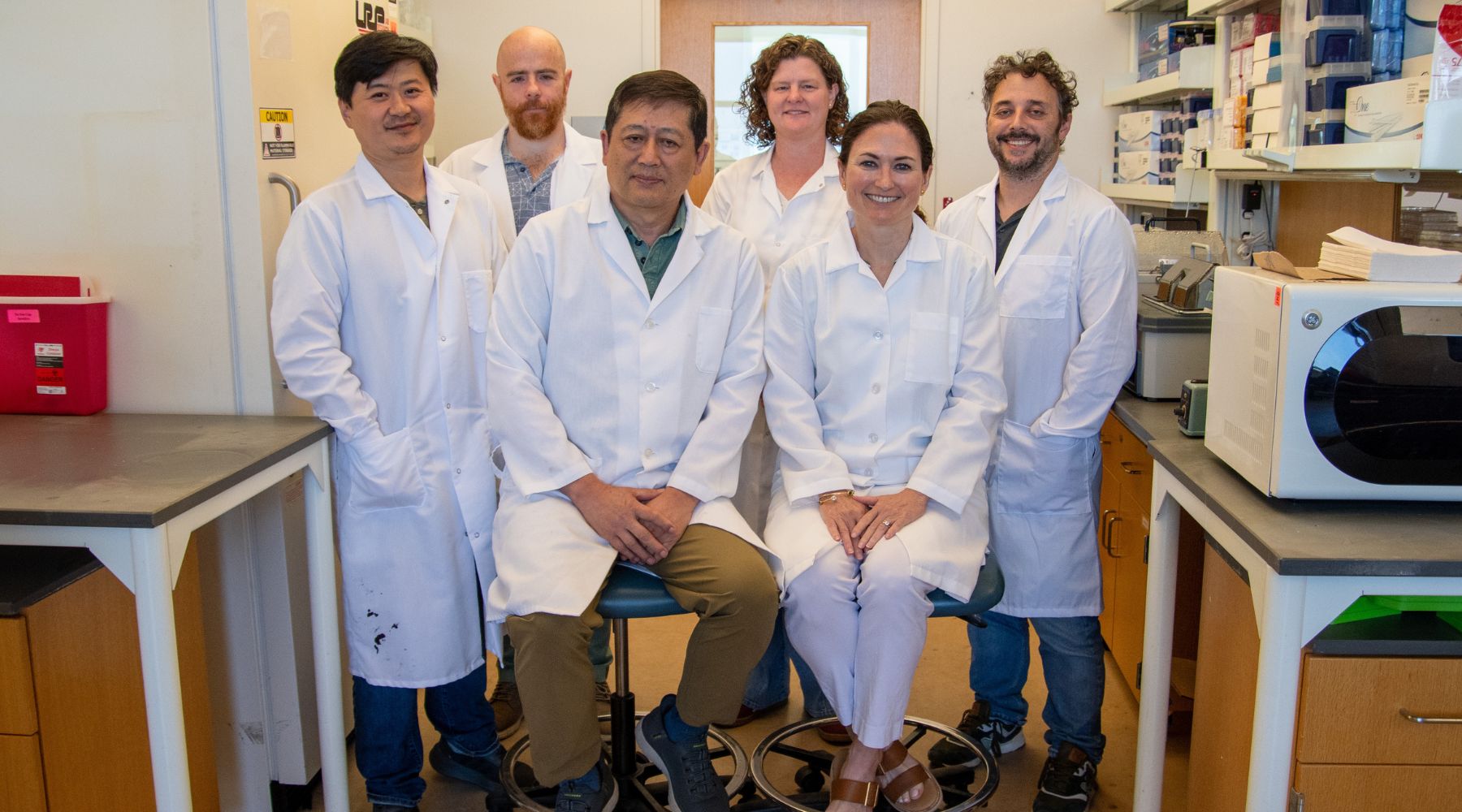
The Oklahoma Medical Research Foundation has received a $12.8 million federal grant to continue building its Center for Cellular Metabolism Research in Oklahoma.
Awarded by the National Institutes of Health, the five-year grant is funded through the NIH’s Centers of Biomedical Research Excellence program, or COBRE. It is one of three active COBRE grants at OMRF.
COBRE grants aim to expand biomedical research capacity in states like Oklahoma that historically receive lower shares of federal research funding. It does this by supporting the research of early career scientists and by providing shared, cutting-edge equipment that otherwise would be cost prohibitive.
This grant will fund the work of four junior scientists whose research all involves cellular metabolism, a set of life-sustaining chemical reactions inside cells. These processes allow cells to produce energy, repair damage and stay alive. But they’re also involved in the development of many chronic diseases, including heart disease, diseases of aging, and autoimmune illnesses.
Lijun Xia, M.D., Ph.D., who leads this COBRE, knows firsthand how they can help a young scientist.
“I was a junior investigator on one of the first COBRE grants OMRF received back in 2003,” said Xia, who holds the Merrick Foundation Chair in Biomedical Research at OMRF. “It launched my career. That’s why I’m so passionate about leading this one.”
Jon Iker Etchegaray, Ph.D., who joined OMRF in 2024 following a post-doctoral fellowship at Washington University in St. Louis, is one of the four young scientists on the grant. He’ll use the funding to study a degenerative eye condition that often comes with aging.
“For me, the value of the COBRE goes way beyond funding my lab,” Etchegaray said. “It’s also the mentorship program, the professional development and the access to tools my lab could never afford. All of those increase my chances of success.”
The grant will also fund the work of these OMRF early career scientists:
- Audrey Cleuren, Ph.D., who studies how cells that line blood vessels can contribute to chronic conditions like neurodegenerative disease and obesity.
- Brian Coon, Ph.D., who is investigating how controlling blood vessel growth could prevent conditions like high cholesterol, strokes and heart attacks.
- Rufei Lu, M.D., Ph.D., who uses advanced technologies to study the cause and progression of autoimmune diseases like lupus.
The three scientists established their labs at OMRF following fellowships, respectively, at the University of Michigan, Yale University School of Medicine, and University of California, San Francisco.
“COBRE funding has played a significant role in our ability to recruit top scientific talent from across the country,” said OMRF Vice President of Research Courtney Griffin, Ph.D. “This grant will now help us develop our next wave of great scientists.”
The grant, No. 2P20GM139763-06, is funded by the National Institute of General Medical Sciences, part of the NIH.