

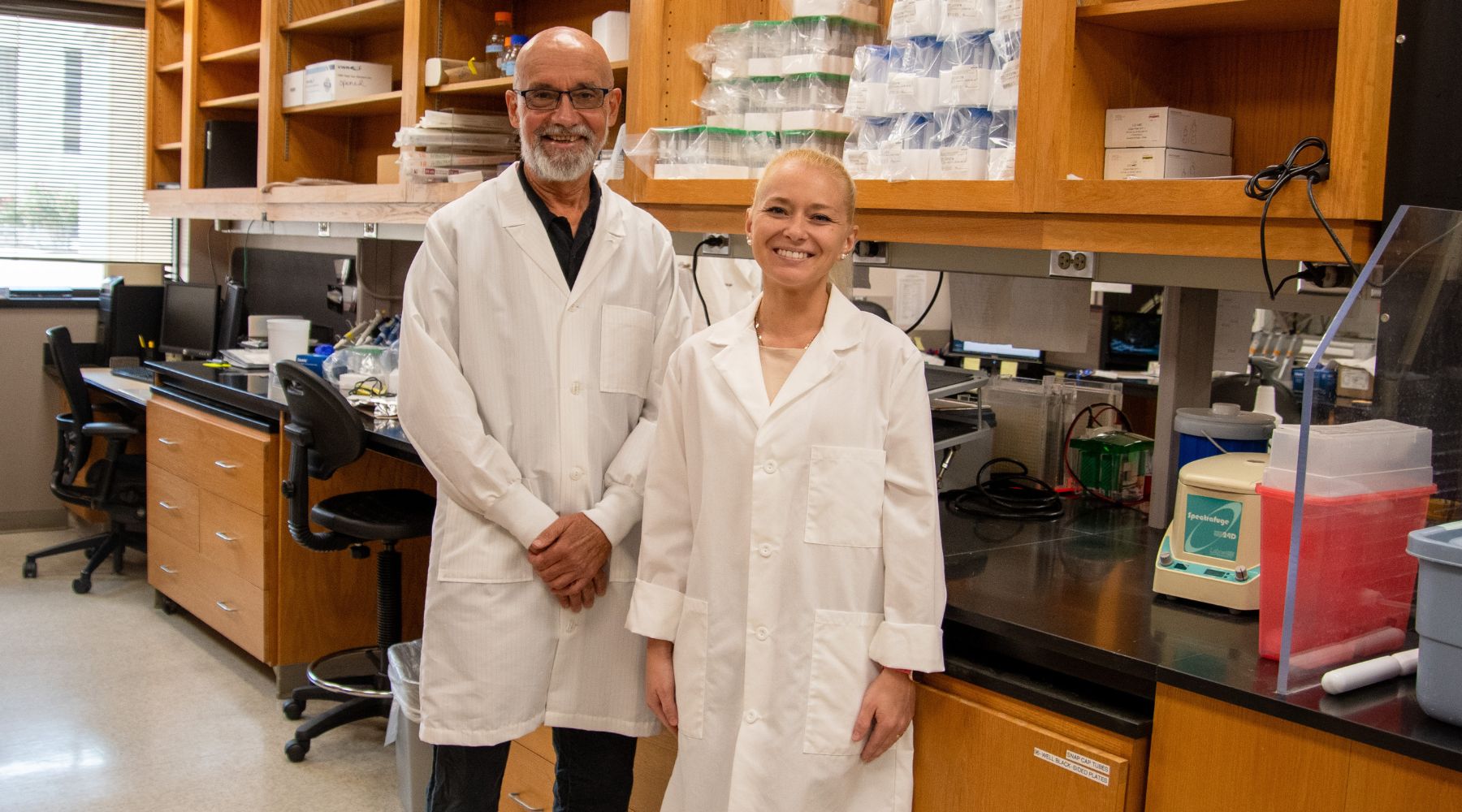
A team of researchers that includes a group of Oklahoma Medical Research Foundation scientists has upended conventional wisdom about how cells interact. Their new finding holds far-reaching implications for conditions including cancer.
For decades, scientists have known that bacteria can exchange genetic material, allowing traits such as antibiotic resistance to spread rapidly through bacterial populations. Until now, however, similar DNA sharing between human cells was not thought to occur.
“Now we know otherwise,” said OMRF’s Gary Gorbsky, Ph.D., who holds the W.H. and Betty Phelps Chair in Development Biology at OMRF.
The new research centers on chromosomes, thread-like structures found in the center of living cells. Containing tight coils of DNA, chromosomes carry genetic information.
“These findings show us that chromosomal abnormalities from one cell can infect a neighboring healthy cell,” said Gorbsky. “It provides evidence for a new mechanism by which genetic abnormalities, such as those found in many cancers, can spread.”
Researchers at the University of Texas Southwestern in Dallas led the study. The results were published in Cell, a leading scientific journal.
Using cells cultured in a dish, the researchers observed that whole chromosomes or chromosome fragments could move into a neighboring cell. Those chromosomes or fragments, which arise when chromosomes are incorrectly distributed during cell division, then became part of the recipient cell.
Maria Narozna, Ph.D., a postdoctoral researcher in Gorbsky’s lab used advanced microscopy to show that adult human stem cells were even more prone to this sharing of chromosomes than other types of cultured cells.
DNA acts as a cell’s instruction manual. When extra DNA enters a cell, it can add new instructions or interfere with existing ones, sometimes changing how the cell behaves.
“Previously, it was thought that when a cell developed a chromosomal abnormality, the problem stayed within that cell and those it creates through cell division,” Gorbsky said. “This discovery tells us that, for example, a cancer cell can transfer genes into a healthy cell and cause it to become more malignant and resistant to therapy.”
UT Southwestern scientists uncovered the process while studying how cells respond to DNA damage caused by chemotherapy and radiation treatment. Subsequently, they documented it in a variety of human cell types, including cells derived from the retina, kidney and cervical cancer, as well as adult stem cells studied in Gorbsky’s lab.
Gorbsky and other cell biologists are now pondering the potential ramifications of DNA transfer between cells. In that sense, he said, this finding lays the groundwork for disease-specific studies that haven’t yet been contemplated.
“There are many open questions,” said UT Southwestern’s Peter Ly, Ph.D., who led the study. “We now want to understand how widespread this process is, how it is regulated at the cellular and molecular levels, and what role it may play in human health and disease, including cancer. These findings may have important implications for understanding how cancer genomes evolve and acquire large-scale chromosomal alterations.”
This discovery was made possible in part through grant No. R35GM126980 from National Institute of General Medical Sciences, part of the National Institutes of Health, and additional funding from the Oklahoma Center for Adult Stem Cell Research, a program of the Oklahoma Tobacco Settlement Endowment Trust (TSET).