

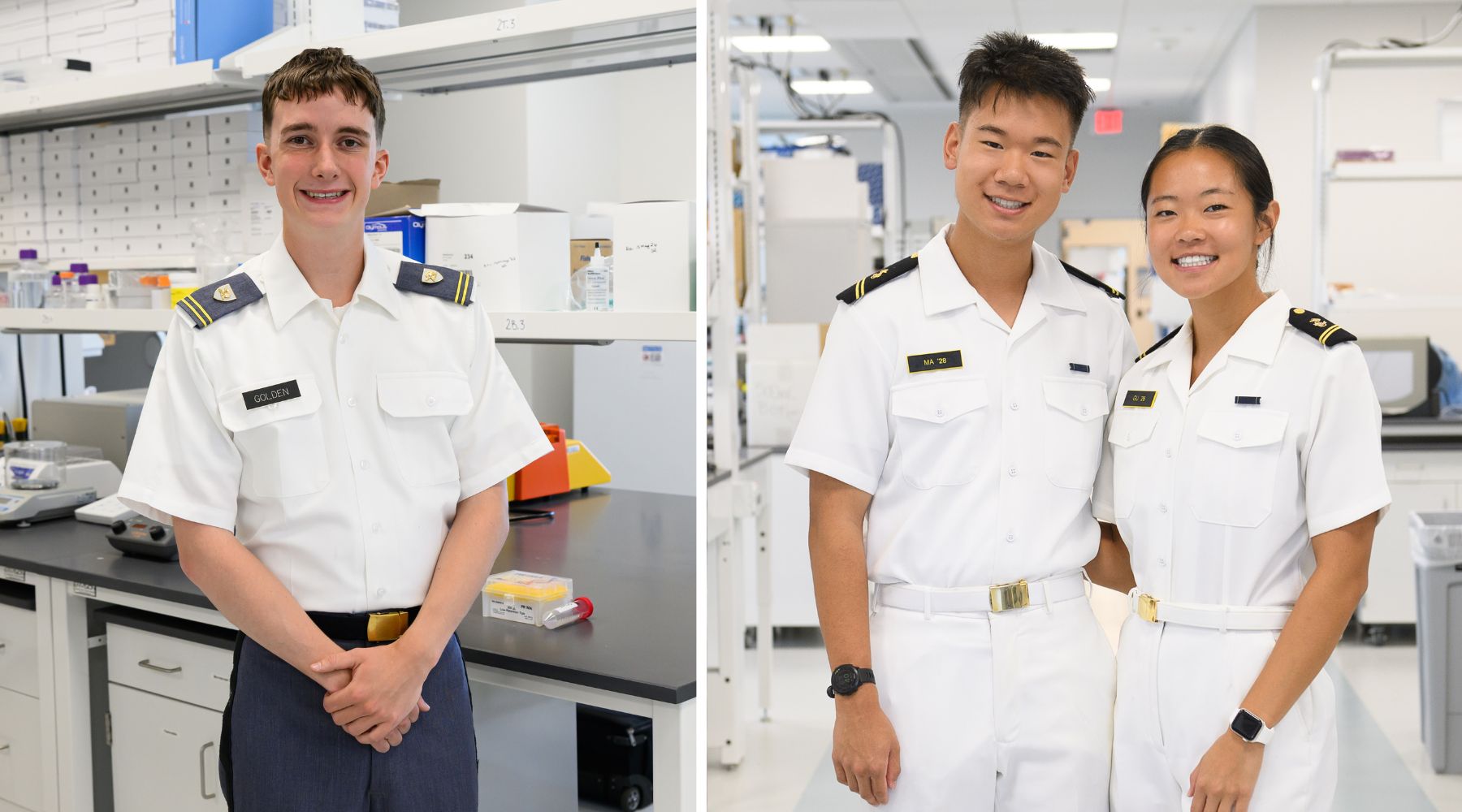
As May turned to June, Emma Gu was serving on a fast-attack submarine off the Connecticut coast. Her classmate at the U.S. Naval Academy, Daotian Ma, was on a transport ship in the Caribbean. Meanwhile, at the U.S. Military Academy, Michael Golden was leading drills as a platoon sergeant.
Within days, each would temporarily trade their military uniform for a lab coat at the Oklahoma Medical Research Foundation. All three interned through the foundation’s John H. Saxon Service Academy Summer Research Program.
The students, each of whom aspires to become a military physician, worked alongside OMRF scientists on projects ranging from cancer biology to diabetes and genetic disorders. Since 2009, the summer program has offered service academy students firsthand experience in biomedical research.
“It’s been awesome to work with people from all over the world,” Gu said. “You see scientists at every stage of their careers, and it really feels like a community.”
At OMRF, Gu studied how microscopic structures move chromosomes during cell division. Understanding that process could help unravel the mysteries of developmental disorders and cancer, which can occur when chromosomes are distributed incorrectly.
Ma interned in the lab of Jaya Krishnan, Ph.D., who investigates diabetes using Mexican cavefish. By studying how the small creatures responds can go for months without eating, the OMRF researcher hopes to discover new approaches for treating metabolic diseases in people.
“I learned that research takes a lot of patience,” Ma said. “Everyone has different projects, but they’re all connected to a bigger goal.”
Meanwhile, Golden investigated meiosis, a form of cell division that produces eggs and sperm. His research focused on why chromosomes sometimes fail to separate properly, a mistake that can lead to pregnancy loss or to inherited conditions like Down syndrome or Turner syndrome.
“I’ve done some research at West Point,” Golden said, “but my hope was that seeing it in a professional setting like OMRF would be helpful – and it has been.”
Although the students worked in different labs, each emphasized the welcoming culture they discovered. “The labs feel like families,” Gu said. “People care about each other, not just the science.”
OMRF Board member John Saxon III, M.D., of Muskogee, created the internship program to honor his father, a West Point graduate and career Air Force pilot who taught at the U.S. Air Force Academy. More than 50 service academy students have now completed OMRF internships.
“I’m really grateful for the Saxon program,” Ma said. “There aren’t many opportunities like this.”