

Since 1956, the Oklahoma Medical Research Foundation has hosted nearly 700 high school and college students for an eight-week introduction to hands-on biomedical research.
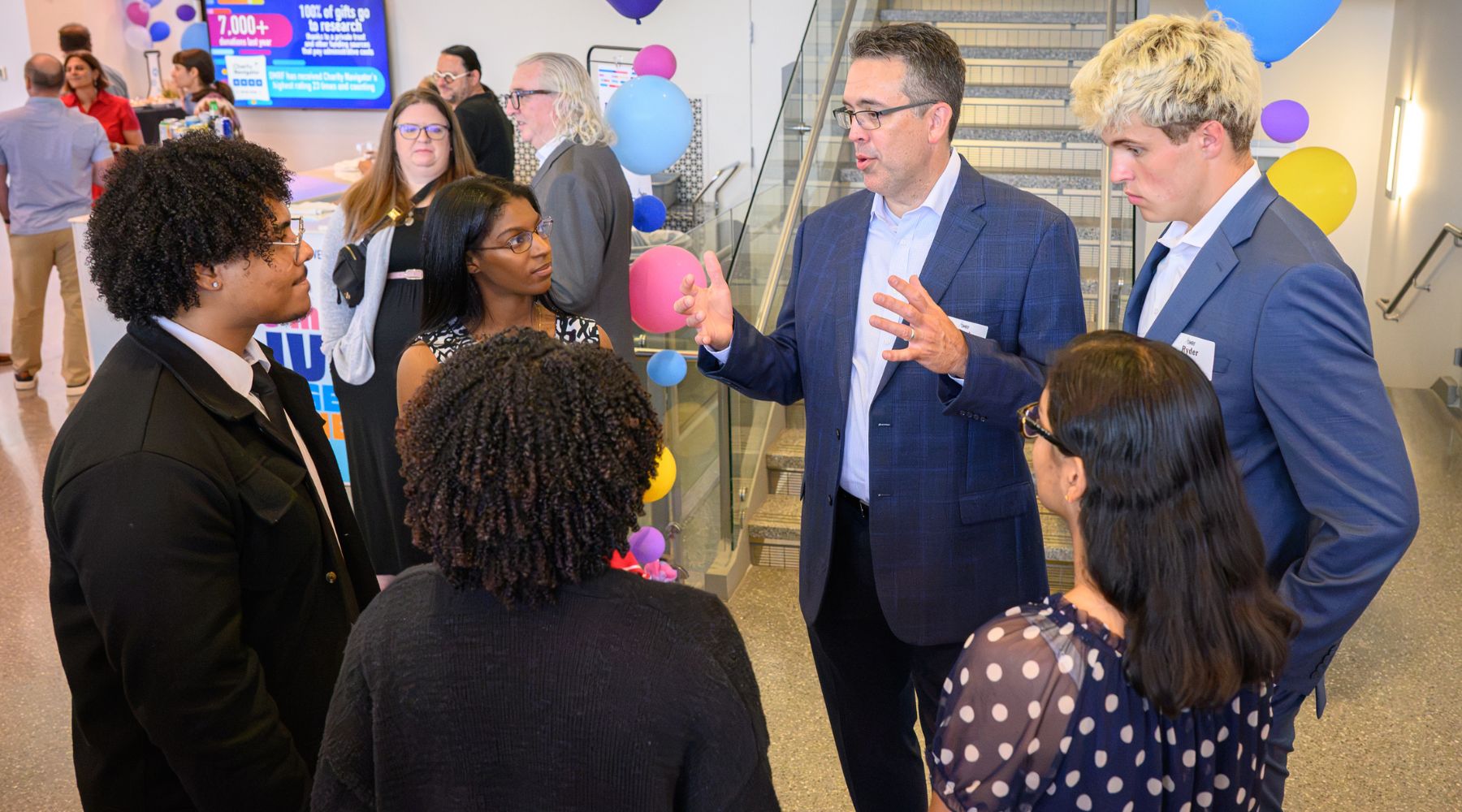
Many returned Thursday evening to celebrate the 70th anniversary of the Sir Alexander Fleming Scholars Program. Many credited their OMRF experience with launching their careers in science, medicine or both.
“I still remember getting that call in 1989 telling me I’d been accepted,” said Dr. Derek Byers, now a physician-scientist at Washington University in St. Louis. “Being a Fleming Scholar was a nascent experience. It changed my life.”
Alumni spanning the decades from the past 70 years attended the event. The oldest was Robert Owen, M.D., a professor emeritus at the University of California, San Francisco, School of Medicine, and a member of the second class of Fleming Scholars in 1957.
That summer served as a springboard for a half-century conducting clinical research. After obtaining his medical degree, Owen focused on public health. He joined the U.S. Centers for Disease Control and Prevention and was on the team that helped eradicate smallpox worldwide. He also developed expertise in infectious intestinal diseases, AIDS and medical conditions suffered by American troops returning from Vietnam following exposure to Agent Orange, a highly toxic herbicide.
“Not bad for a kid from Bartlesville,” Owen said. “My experience as a Fleming Scholar piqued my interest in research, so, obviously, it had a foundational impact on me.”
Like Owen and Byers, Judith James’ OMRF internship helped launch a career that combined laboratory research with clinical care. A native of Pond Creek, Okla., she arrived at OMRF planning to become a pediatrician. As part of her internship, James shadowed an OMRF physician-researcher caring for two 19-year-old women with the autoimmune disease lupus. One died that summer, and James’ life was forever changed.
She shifted her focus to rheumatology and autoimmune diseases and became the first graduate of the University of Oklahoma Health Science Center’s M.D./Ph.D. program. Today, she is OMRF’s executive vice president and chief medical officer and one of the world’s foremost experts on lupus. She is also the first woman from an Oklahoma institution elected to the National Academy of Medicine.
“Some of you came into the lab knowing that you wanted to become a scientist,” she told the group. “I had no idea, because I had never even seen a scientist, much less interacted with one. My Fleming experience showed me what science could look like.”
The program is named for Sir Alexander Fleming, the British scientist who discovered penicillin and who traveled to Oklahoma City for OMRF’s dedication ceremony in 1949.
For this year’s Fleming Scholars, hearing from the program’s alumni was inspiring. And, for at least one scholar, it was also reassuring.
“I came here not really knowing whether research was for me,” said Saif Al Hashimi, a Norman High School graduate now attending Colgate University. “This summer has changed my opinion, but it was nice hearing former Fleming Scholars say they had the same uncertainty when they first came to OMRF.”