

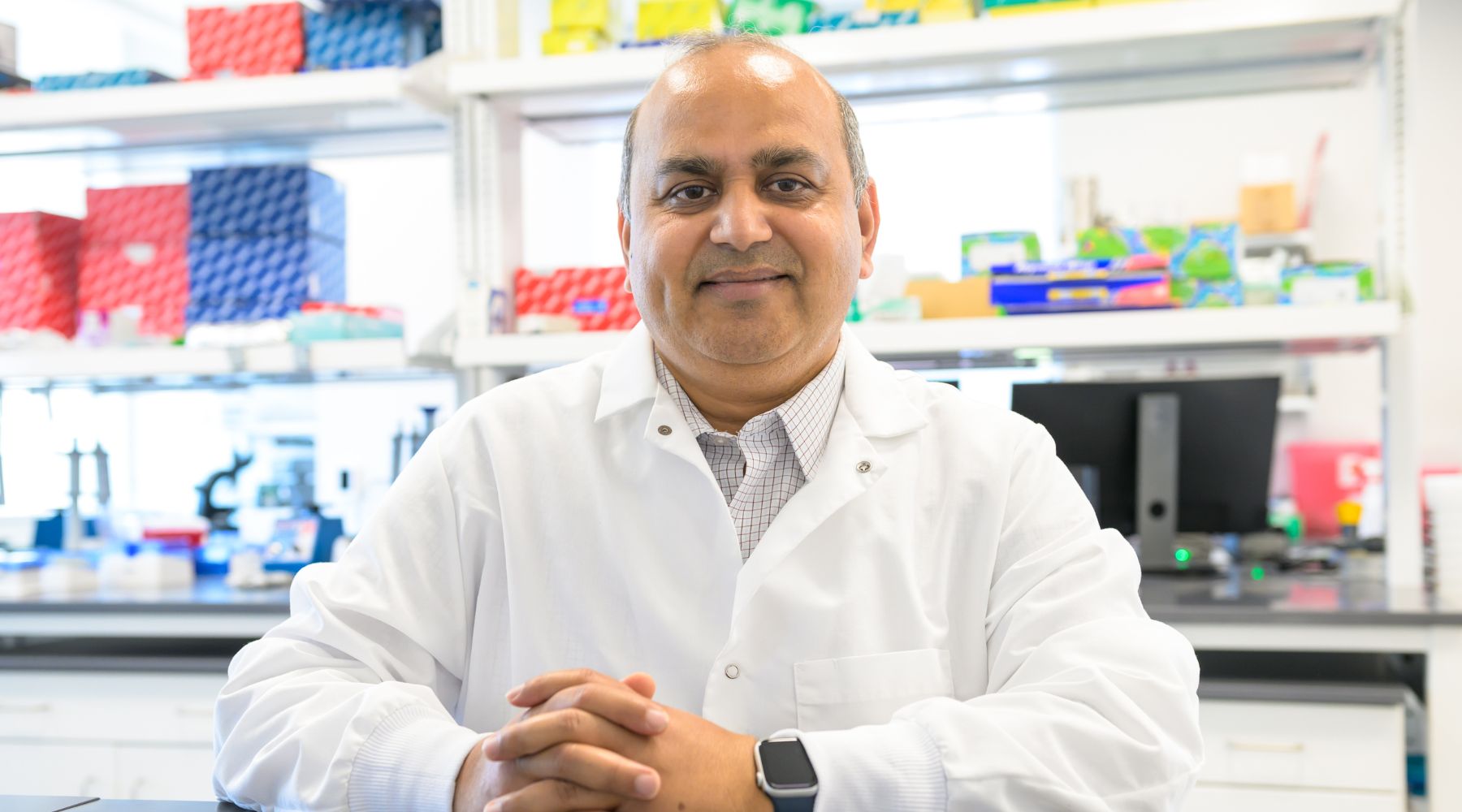
An Oklahoma Medical Research Foundation scientist has developed a method that could one day help make rare genetic disease diagnosis faster and more precise. With a $3.2 million grant from the National Institutes of Health, he aims to make this platform available to others who study genetic diseases.
When someone with a rare or unidentified condition undergoes genetic testing, results often show many variants in their DNA. However, doctors don’t know which of these variants are harmless and which may be causing the condition.
To distinguish between changes that are harmless and those that can trigger disease, scientists often turn to “models” – other creatures whose genetic make-up overlaps with ours.
For OMRF’s Gaurav Varshney, Ph.D., that process involves experiments with zebrafish. The small, striped tropical fish are a favorite of genetic researchers like Varshney, who keeps thousands in tanks for research at OMRF and leads the project.
Varshney has developed a technique using the gene-editing tool known as CRISPR that lets him create specific genetic changes in zebrafish and then study what effects, if any, those errors produce.
“Zebrafish are remarkably useful for studying human disease because more than 80% of human disease-associated genes have a corresponding gene in zebrafish,” said Varshney. “Their similarities and fast development mean we can observe results in a matter of days.”
Varshney’s technique also works in other experimental models like mice, which will further help researchers pinpoint the effects of genetic mistakes that could be at the root of rare human diseases.
“Right now, families can wait years for a clear answer about a genetic change, and too often that answer never comes,” Varshney said. “Our goal is to put these tools in the hands of the whole research community so everyone can study these variants more quickly and accurately.”
While Varshney has been working on this technique for years, this new grant will help develop a platform so that other scientists can employ it in their work.
“Most grants are not specifically set up for developing new or improved ways of doing experimental science,” said Patrick Gaffney, M.D., who leads OMRF’s Genes and Human Disease Research Program. “Eventually, these tools or versions of them could be used to understand what mutations in human genes do to cell function and lead to a better understanding of genetic diseases.”
By combining improved gene-editing technologies with artificial intelligence tools, the project also aims to make it easier for researchers to study the biological effects of genetic variants whose significance is currently unknown.
Varshney’s grant, No. 1R24OD040592, was awarded by the National Institutes of Health Office of the Director and Office of Research Infrastructure Programs. He received funding for preliminary research from the Presbyterian Health Foundation.
This content is solely the responsibility of the authors and does not necessarily represent the official views of the National Institutes of Health.