

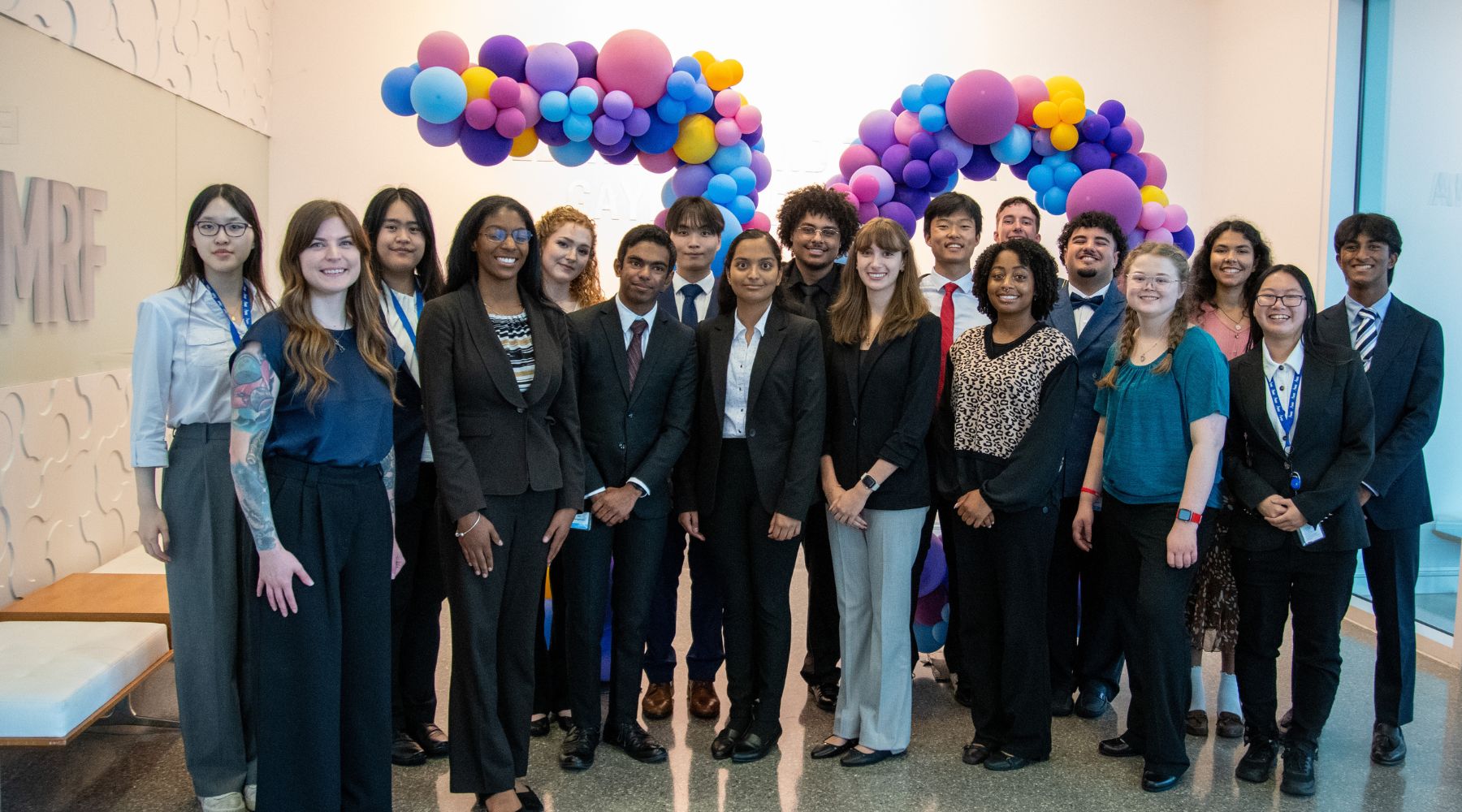
While most of their friends spent the summer relaxing or working traditional jobs, 21 college students investigated diseases including heart failure, cancer and Alzheimer’s while working with scientists at Oklahoma Medical Research Foundation.
They are returning to class this month with their first real-world experience in a biomedical research lab.
Alex Kidangathazhe, a 2026 Stillwater High School graduate, studied the use of a potential new drug to reduce inflammation associated with heart failure. He is now at Stanford University, planning to major in biomedical engineering.
One surprising takeaway from his summer experience: “I learned that you can have heart failure without ever suffering a heart attack,” Kidangathazhe said.
He was among 15 students who served as Sir Alexander Fleming Scholars. The program, which celebrated its 70th anniversary this year, is open to students from across the state. It’s named for the British scientist who discovered penicillin and came to Oklahoma City to dedicate OMRF’s first building.
Kidangathazhe called his OMRF internship “invaluable,” adding, “The level of independence given to me by OMRF and my mentor helped me develop confidence as a scientist and confirmed my interest in pursuing research as a career.”
Nojua Malone, a nursing major at Langston University, studied a newly discovered relationship between two genes linked to cancer. The experience, she said, “gave me a glimpse of a scientist’s life – the hard days when the experiments don’t work and the triumphant days when you finally see some results.”
Malone was one of three students who interned through the Langston University Biomedical Research Scholars Program, a partnership between OMRF and Oklahoma’s only historically black university.
Emma Gu, an aspiring physician and incoming junior at the U.S. Naval Academy, left a submarine off the Connecticut coast to participate in OMRF’s John H. Saxon Service Academy Summer Research Program.
One of three Saxon program interns, Gu studied how microscopic structures move chromosomes during cell division. Understanding this process is critical, because developmental disorders and cancer can occur when chromosomes are distributed incorrectly.
“It’s been awesome to work with people from all over the world,” she said. “You see scientists at every stage of their careers, and it really feels like a community.”
The Saxon program was created by OMRF Board member John Saxon III, M.D., of Muskogee. It honors his father, a West Point graduate and career Air Force pilot who taught at the U.S. Air Force Academy. More than 50 service academy students have participated since the program began 2009.
Training future scientists is one of OMRF’s core values, said Ashley Cheyney, Ph.D., the foundation’s director of scientific training and outreach. “I think that demonstrates the importance we place on our internship programs.”
As their internship ends, students often tell Cheyney how the experience provided direction regarding their future career path. “We are excited to see where that path leads for these students,” she said.
Applications for OMRF’s 2027 internship programs will open this fall. For more information, visit omrf.org/SummerScholars.