
We’ve all heard that “an apple a day keeps the doctor away.” According to new research from the Oklahoma Medical Research Foundation, apples have company when it comes to fruits that keep us healthy.
The research, published in the scientific journal Antioxidants, found that daily strawberry intake reduced blood sugar levels in people who were at risk of developing Type 2 diabetes.
“Our research seems to provide concrete evidence about the health benefits of eating strawberries,” said Hal Scofield, M.D., an OMRF physician-scientist who co-authored the study with Arpita Basu, Ph.D., a nutrition professor at the University of Nevada, Las Vegas, who led the project.
Their study involved 25 patients from UNLV’s diabetes clinic. All were classified as prediabetic because their blood glucose levels were elevated, but not high enough to require medication.
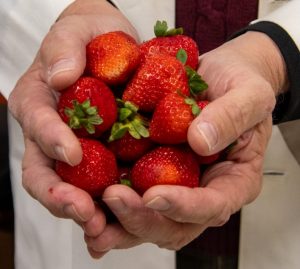
For 12 weeks, half drank a daily shake containing the equivalent of 2.5 cups of strawberries – about 20 berries – while the other half made no dietary changes. After a four-week “washout” period to flush the effects from their bodies, participants switched roles for 12 more weeks.
The results: All 25 participants had lower blood sugar levels when tested immediately after 12 weeks of strawberry consumption, with many returning to the normal range, Basu said. However, when they were tested again 12 weeks later, their blood sugar readings returned to their original levels.
“What that tells us is that maintaining the glucose-lowering benefit requires consistent consumption of strawberries,” she said.
In a previous study, Scofield and Basu found that daily strawberry concoction lessens the risk of heart disease, stroke and diabetes in people with obesity.
Berries are rich in polyphenols, a naturally occurring compound with antioxidant and anti-inflammatory qualities. For that reason, Scofield said, it’s likely other berries would have similar effects.
Scofield cautioned that these results don’t mean that eating strawberries is a cure for high blood sugar. However, the study and others like it point to the potential benefits of long-term berry consumption, he said.
“We probably all heard the same command from our parents to eat more fruit,” Scofield said. “Turns out, Mom and Dad probably knew what they were talking about.”
This study was funded by the California Strawberry Commission and by grant No. U54GM104938 from the National Institute of General Medical Sciences, part of the National Institutes of Health.