

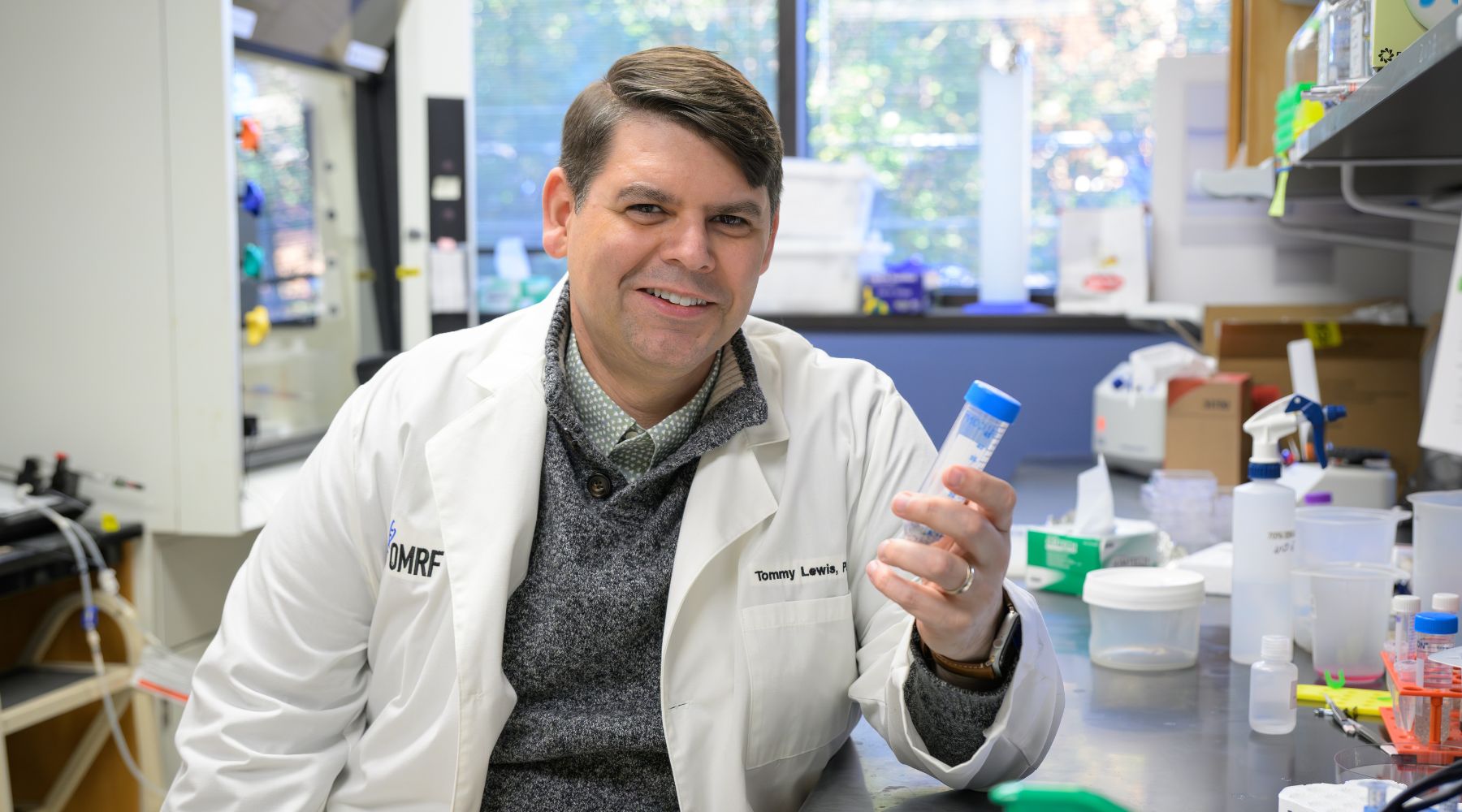
An Oklahoma Medical Research Foundation scientist, backed by a $2.3 million grant, will investigate the many roles of the mitochondria, often called the powerhouse of the cell.
The National Institutes of Health awarded the grant to Tommy Lewis, Ph.D., whose lab studies the importance of mitochondria in brain function.
“Mitochondria are best known for generating the energy a cell needs,” Lewis said. “But they also have other purposes, and we’ve learned over the past decade that there are different types and shapes of mitochondria, even within the same cell.”
By the end of his five-year grant, Lewis hopes to better understand those purposes and how mitochondria interact with each other. His findings could lay the groundwork for better treatments for diseases such as Alzheimer’s and Parkinson’s and for traumatic brain injuries.
Each neuron contains hundreds and often thousands of constantly adapting mitochondria. Some make energy, some protect the cell, and some have potentially undiscovered roles, Lewis said.
“This raises important questions, like how do they communicate, how do they move to the right place within the cell, and what happens when something goes wrong?” Lewis said.
Answering such questions has been extremely challenging because scientists lacked the tools to watch mitochondria closely or to distinguish one type from another. But recently developed technologies, including high-resolution microscopes and advanced protein analysis, have opened the window for Lewis’s studies.
This research is particularly important in neurons, the brain’s primary cells, because unlike cells in most other parts of the body, neurons don’t regenerate if damaged. This leads to permanent damage in conditions ranging from Alzheimer’s to traumatic brain injuries.
By developing a deeper understanding of the mitochondria, Lewis hopes he can pave the way for strategies that might one day allow for the repair or regeneration of neurons.
And while his project focuses on neurons, Lewis also hopes to test his findings in the mitochondria of muscle cells. That aspect is of particular interest to OMRF scientist Benjamin Miller, Ph.D., who leads the foundation’s Aging & Metabolism Research Program.
“Dr. Lewis’ research is quite relevant to my own work,” said Miller, whose lab studies ways to prevent or reduce the muscle loss that accompanies aging. “Like the neurons in the brain, the muscle has different populations of mitochondria that perform different tasks. We’re still in the infancy of understanding this fascinating division of labor.”
Lewis’s grant, R35GM137921, was awarded by the National Institute of General Medical Sciences, part of the NIH. He previously received funding from the Presbyterian Health Foundation to purchase equipment that proved critical toward this grant.