

My Research
My lab focuses on studying why heart function declines as we age. Older people have significantly higher rates of cardiovascular disease, including heart attack, stroke, and heart failure, compared to younger individuals. But also, elderly people with no overt cardiovascular disease still exhibit declines in cardiac function, which can lead to exercise intolerance and a cascade of other negative consequences. How does this happen?
My research program focuses on dissecting the molecular mechanisms of cardiac aging and age-related diastolic dysfunction. We use in vivo and in vitro approaches to study the physiological, biochemical and proteomic changes of cardiac aging in mouse models.
NAD+ is an essential redox cofactor for cellular energy metabolism and a substrate for NAD+-dependent enzymes like sirtuins. Numerous studies have shown that NAD+ levels decline withage and in multiple age-related diseases. NAD+ boosting strategies like NAD+ precursor supplementation are gaining attention as potential therapies for age-related diseases. These supplementation strategies focus on boosting NAD+ levels in the cell but do not specifically target the critical mitochondrial NAD+ pools. My lab is currently studying the role of a recently discovered mammalian mitochondrial NAD+ transporter (named SLC25A51) in the heart. We believe this study will open new avenues towards developing new interventions to enhance mitochondrial NAD+ metabolism or to maximize the efficacy of NAD+ boosting strategies.
Another project in my lab focuses on heart failure with preserved ejection fraction (HFpEF), which accounts for 50% of all heart failure cases and is a major challenge for cardiovascular medicine. The prevalence of HFpEF increases sharpy with age and HFpEF is considered a disease of older adults. However, preclinical studies on HFpEF mostly employ young animal models and it remains unclear how aging accelerates or precipitates the development of HFpEF. We combine a mouse model of cardiometabolic HFpEF with normal aging to identify novel age-dependent mechanisms that drive HFpEF development.
Research Keywords
- Cardiovascular disease
- Aging
- Mitochondria
- Metabolism
- Proteostasis



Contact
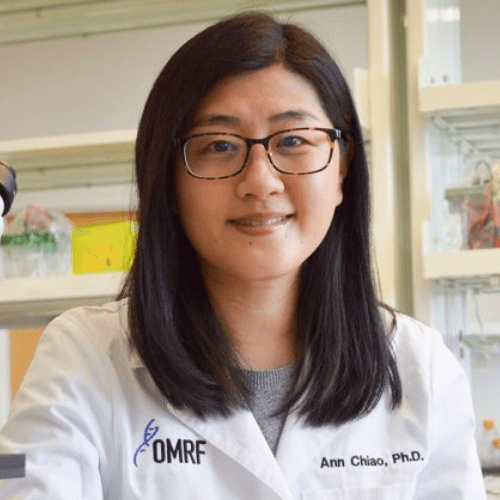
Ann Chiao, Ph.D.
Aging & Metabolism Research Program, MS 46
Oklahoma Medical Research Foundation
825 N.E. 13th Street
Oklahoma City, OK 73104
Phone: 405-271-3116
Fax: 405-271-1437