
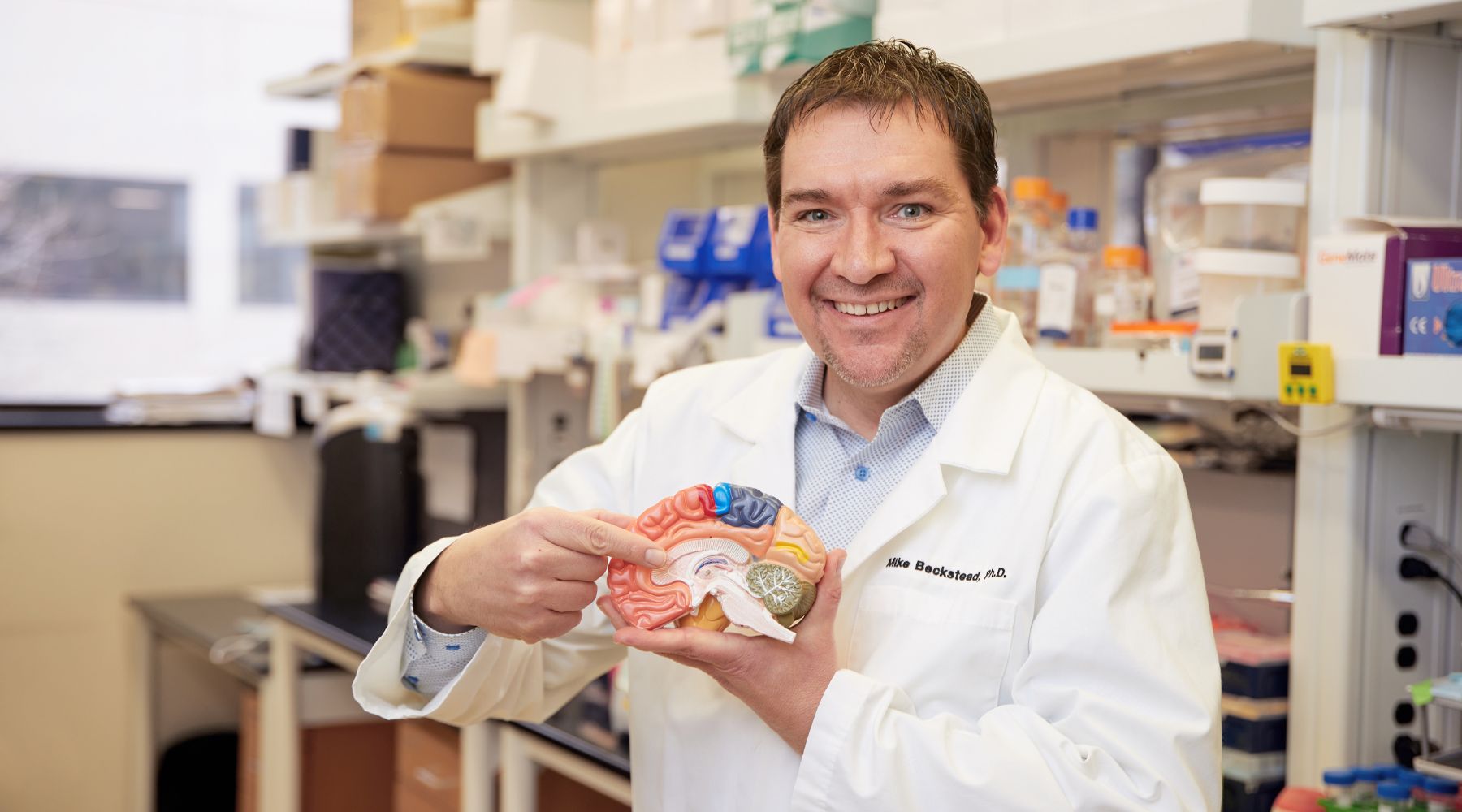
The Oklahoma Medical Research Foundation has received a $3 million federal grant to investigate how methamphetamine triggers a vicious cycle of addiction in the brain.
By the end of the five-year National Institutes of Health grant, OMRF’s Mike Beckstead, Ph.D., hopes to make discoveries about addiction that will apply not just to meth but also to other drugs.
“I think what we learn about brain responses with meth will also be relevant for cocaine, and it may also be transferrable to opioids,” said Beckstead, who holds the Hille Family Foundation Chair in Neurodegenerative Disease Research at OMRF.
According to the National Center for Drug Abuse Statistics, more than 2 million Americans use meth each year. Among U.S. adults who reported using the drug in the past year, more than half met the criteria for methamphetamine use disorder.
With few exceptions, meth addiction worsens over time. While there is no treatment approved by the Food and Drug Administration, Beckstead hopes to change that.
With this grant, Beckstead aims to better understand neurotensin, a molecule within the brain’s reward system. His research involves mouse models in which neurotensin receptors have been removed from various cell types.
“We have reason to believe that inhibiting neurotensin in one or more cell types causes the mice to seek less methamphetamine,” Beckstead said.
Beckstead thinks his study could someday lead to a treatment that acts on neurotensin to suppress the brain’s reward system related to meth and potentially other addictive drugs. Any potential therapeutic would be part of a comprehensive treatment program that includes existing behavioral therapy methods or programs, he said.
“When grant reviewers compared Dr. Beckstead’s application against others from around the country, they scored it in the top 3%,” said OMRF President Andrew Weyrich, Ph.D. “That score reflects both its high scientific merit and its potential impact.”
In other words, said Weyrich, “The scientists who approved this grant see the potential for the research to lead to a breakthrough in treating meth addiction.” That, he said, would be “monumental.”
Beckstead’s grant, No. R01 DA062881, was awarded by the National Institute on Drug Abuse, part of the NIH. His lab previously received funding from the Presbyterian Health Foundation for preliminary research leading to this grant.