

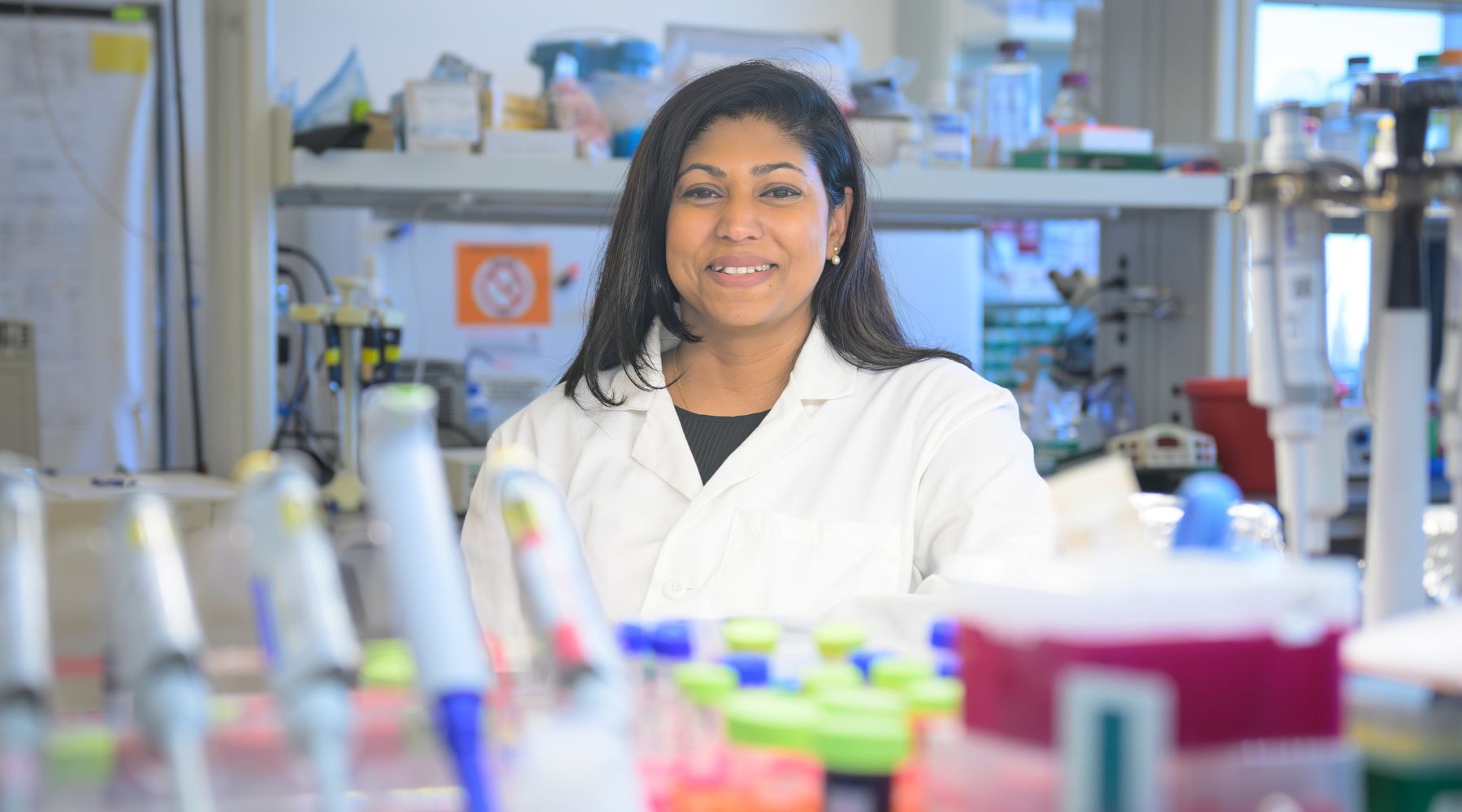
A three-year grant from the American Heart Association will fund an Oklahoma Medical Research Foundation scientist’s study of an autoimmune disease that sometimes results in organ failure.
Charmain Johnson, Ph.D., received the American Heart Association’s Career Development Award, which comes with a $240,000 research grant.
Johnson will study the role of a protein called RIPK3 in systemic sclerosis, a disease that affects about 300,000 Americans.
In systemic sclerosis, white blood cells mistakenly attack the body, causing chronic inflammation, vascular damage and progressive tissue scarring in skin and other organs.
Johnson will investigate whether excessive production of RIPK3 causes blood vessels to become leaky, creating a pathway for white blood cells to escape and contribute to tissue scarring. She hopes to show that the protein’s absence leads to fewer white blood cells traveling to the lungs.
“My study focuses on the lung, as it is the leading cause of morbidity and mortality in systemic sclerosis and currently lacks effective treatment,” Johnson said. “I expect to find that without RIPK3 in the blood vessels, we can slow disease progression.”
The findings ultimately could lead to a treatment aimed at preventing interstitial lung disease, a primary cause of death associated with systemic sclerosis.
Johnson is a postdoctoral fellow in the lab of OMRF’s vice president of research, Courtney Griffin, Ph.D., who called Johnson’s research “extremely promising.”
Separately, the American Heart Association recently awarded a two-year, $70,000 grant to Irma Gryniuk, a graduate student at OMRF who will investigate two eye diseases marked by the abnormal growth of retinal blood vessels.
Griffin, who received grants from the American Heart Association as a graduate student and a postdoctoral researcher, understands the role they can play in launching a researcher’s career.
“An AHA award keeps young scientists invested and committed to cardiovascular biology because it makes them feel like they’re part of the research community,” Griffin said. “The awards I received as a trainee helped keep me in the field for 30 years.”