

Scientists at the Oklahoma Medical Research Foundation have discovered a way to reverse the effects of heart disease in diabetic mice.
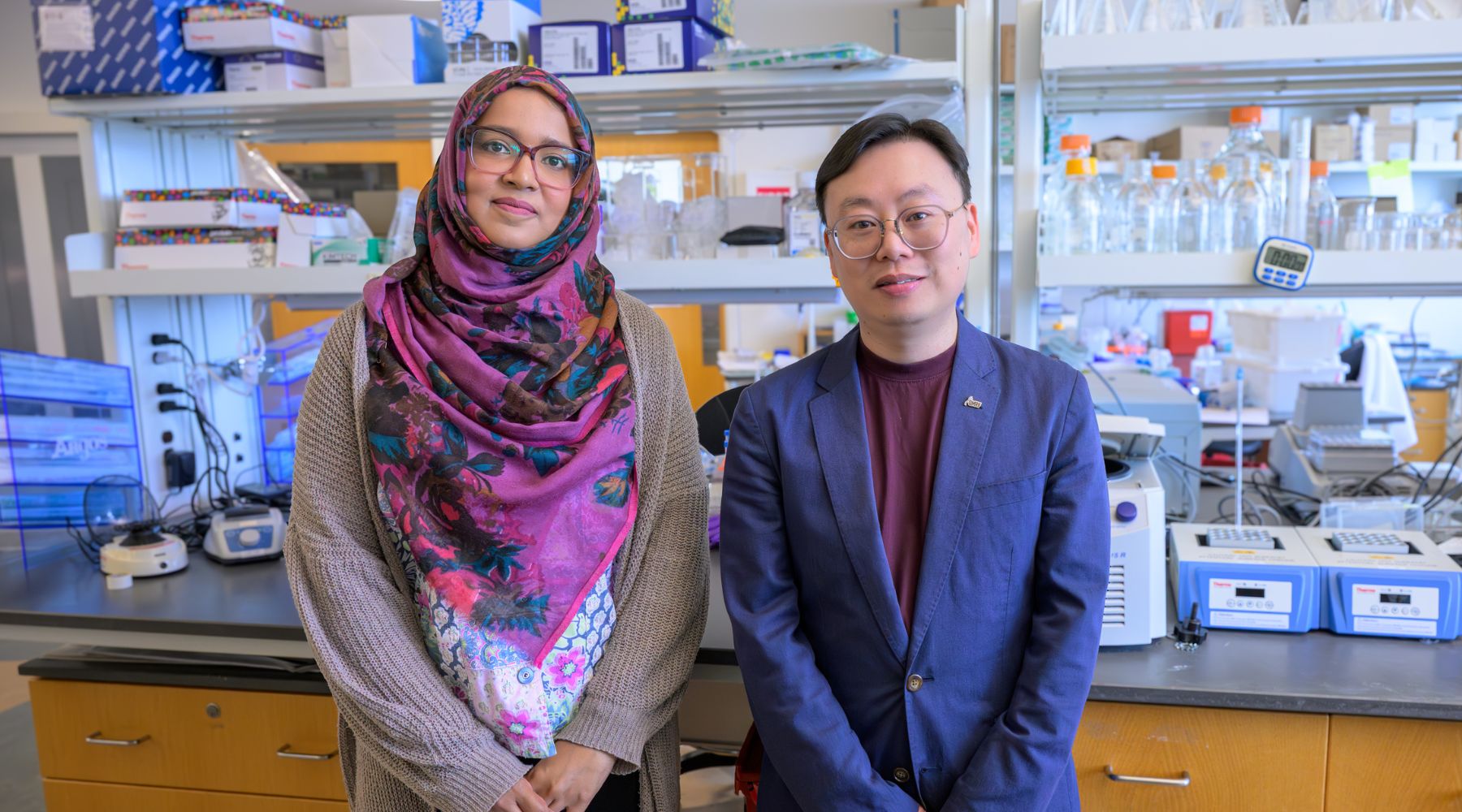
Scientist Chi Fung Lee, Ph.D., and postdoctoral researcher Hina Nizami, Ph.D., made the breakthrough. If confirmed through further study, it could ultimately lead to a drug for the most common cause of death in people with diabetes.
“This discovery has potential to help millions of people worldwide,” said OMRF Vice President of Research Courtney Griffin, Ph.D.
Lee and Nizami made the discovery by inhibiting a specific protein in mice with diabetes. “Everyone has this protein, known as SARM1, and normally it remains in a dormant state within our cells,” Lee said. “For reasons we don’t fully understand yet, SARM1 becomes overactive when people develop diabetes.”
This overactivity causes metabolic changes that result in diabetic heart disease.
According to the Centers for Disease Control and Prevention, diabetic patients are twice as likely as the general public to develop heart disease, and that risk increases with each year someone has diabetes. One study found that almost 5 million diabetic Americans live with heart disease. That includes tens of thousands of people in Oklahoma, where one in eight residents have diabetes.
The protein at the center of Lee’s and Nizami’s research, SARM1, appears to interfere with vital heart function and metabolism. “You might think of your heart as the body’s engine and SARM1 as a leak that robs your engine of the oil it needs,” Nizami said.
Lee’s lab discovered that by using a molecule to inhibit SARM1, mice recovered 50% of their lost heart function over a four-week treatment period. OMRF has filed for a patent on the work, which has since progressed with support from OKBioStart, a program of the University of Oklahoma funded by a grant from the U.S. Economic Development Authority.
The new findings appear in Circulation Research, a journal published by the American Heart Association.
“The findings need additional research, but what’s striking is that these studies show promise for not only stopping tissue damage but reversing it,” Griffin said. “That’s a goal every biomedical scientist hopes to achieve.”
The research was supported by grant No. 5R01HL164854 from the National Heart, Lung, and Blood Institute, 5P20GM139763 from the National Institute of General Medical Sciences, and 5R01AG081855 from the National Institute on Aging, all of which are part of the National Institutes of Health; the American Heart Association; and the Oklahoma Center for Adult Stem Cell Research, a program of the Tobacco Settlement Endowment Trust.