

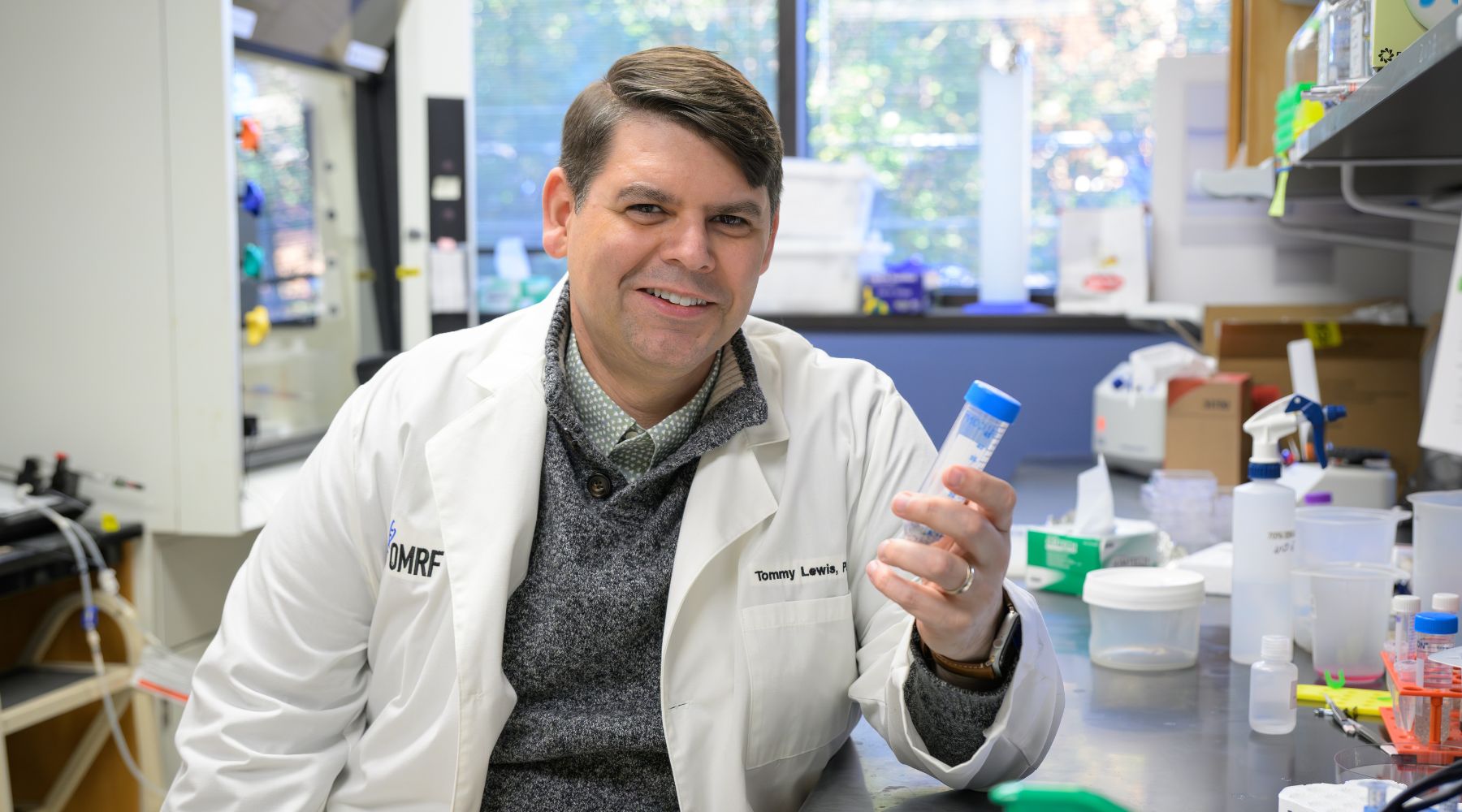
Cellular deterioration in the brain begins long before someone with Alzheimer’s shows symptoms. An Oklahoma Medical Research Foundation scientist, backed by a new National Institutes of Health grant, will explore whether this deterioration can be stopped.
Tommy Lewis, Ph.D., will lead experiments focused on the reduction of connectors between neurons in the brain. In Alzheimer’s, the decline of these connectors, called dendritic spines, is pronounced and is linked to memory loss.
The National Institute on Aging, part of the NIH, recently awarded OMRF a four-year, $2.6 million grant for Lewis’s research. It approved the grant before the federal government shut down over an ongoing funding dispute.
In Alzheimer’s, the loss of dendritic spines occurs at the same time as fragmentation of the mitochondria, which produce energy for cells. Based on his lab’s previous work, Lewis believes both events are caused by hyperactivation of a protein called AMPK.
“Using a mouse model of Alzheimer’s, we now want to see whether we can protect brain cells by blocking the activity of that protein at the mitochondria,” said Lewis.
OMRF scientist Benjamin Miller, Ph.D., who leads the foundation’s studies on aging and metabolism, has a separate interest in Lewis’s experiments. AMPK is thought to be activated by the diabetes drug metformin, which Miller’s lab recently tested in people to study its anti-aging effects.
“Dr. Lewis is trying to understand why AMPK activation through drugs like metformin have conflicting results. The answer may depend on whether the brain is healthy or whether it has progressed to Alzheimer’s,” Miller said. “His research will provide the medical community more evidence.”
Lewis’s grant is No. 1RF1AG090599-01A1. Previous funding from the Presbyterian Health Foundation purchased scientific equipment that was instrumental in securing the new grant.