

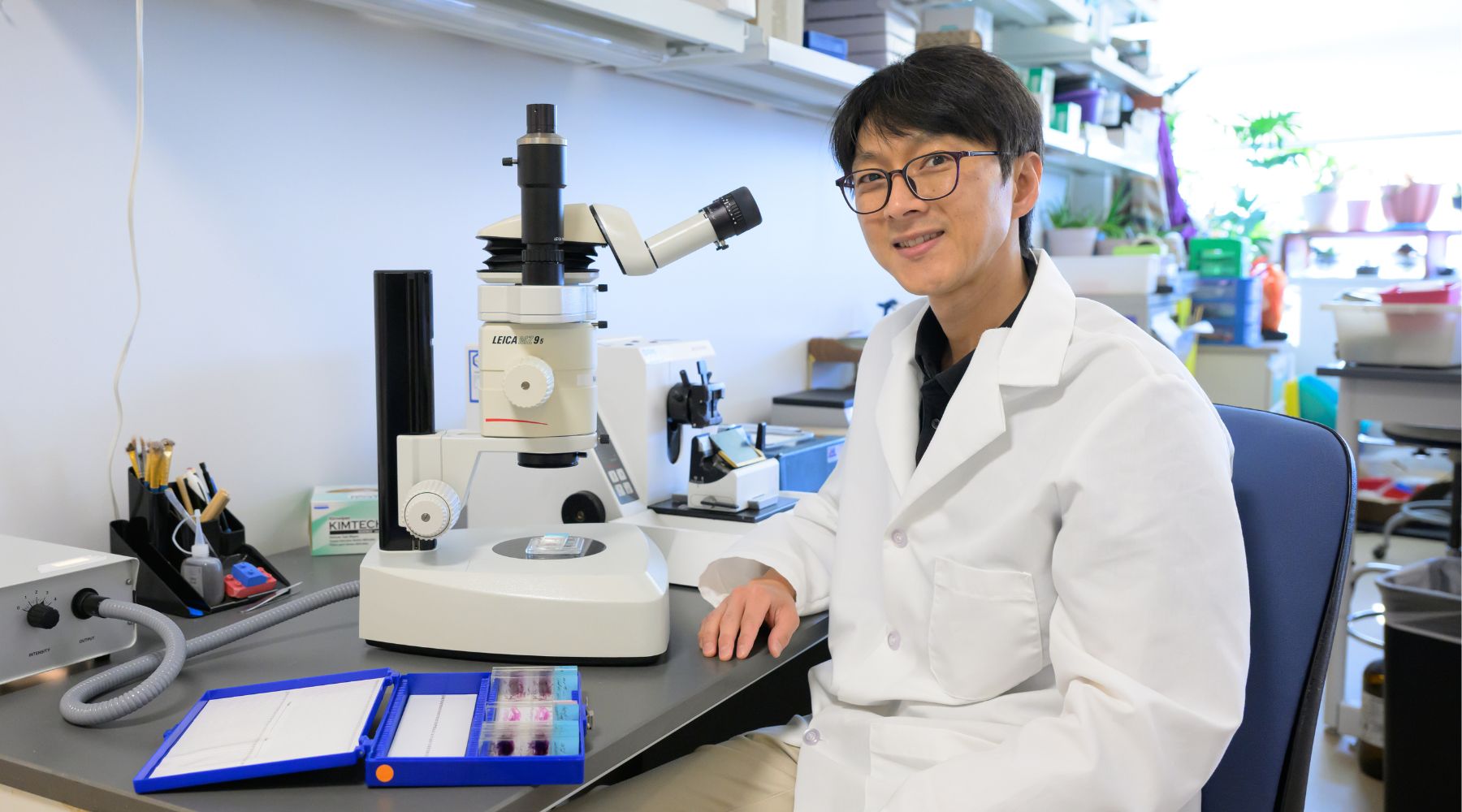
With his first significant grant from the National Institutes of Health, an Oklahoma Medical Research Foundation scientist will investigate how bone marrow forms inside the skull. His findings ultimately could lead to improved treatment options for brain injuries and diseases.
The grant awarded to Hae Ryong Kwon, Ph.D., is part of a program to test new ideas or collect early data toward a potentially larger grant later. His $341,000 award covers two years of study.
Kwon is a research assistant professor at OMRF and studies a protein called PDGF, which is critical to wound repair.
Our bodies require a careful balance of this protein. Too little causes inadequate wound repair, while too much leads to excessive collagen buildup, resulting in thickening and scarring in tissue and bones. Kwon will investigate how a specific receptor for the protein contributes to the formation of the skull’s bone marrow.
“The PDGF receptor appears to play an important role in this process,” he said. “Early results suggest that when this receptor is activated in bone-forming cells, bone marrow grows more.”
Because skull bone marrow is so close to the brain, Kwon said it may someday be possible to help physicians monitor brain diseases or injuries. For example, changes in skull bone marrow may help doctors detect brain damage earlier or track how a disease is progressing.
Scientist Lorin Olson, Ph.D., who serves as a mentor to Kwon at OMRF, said the new studies could one day lead to new ways to deliver therapeutic treatments to the brain. “The brain can be quite difficult to treat, so using skull bone marrow as a pathway or delivery site would open new possibilities for treating brain injuries and neurodegenerative diseases.”
Kwon received the grant, No. R03DE034789-01A1, from the National Institute of Dental & Craniofacial Research, part of the NIH.