

Adam’s Journal
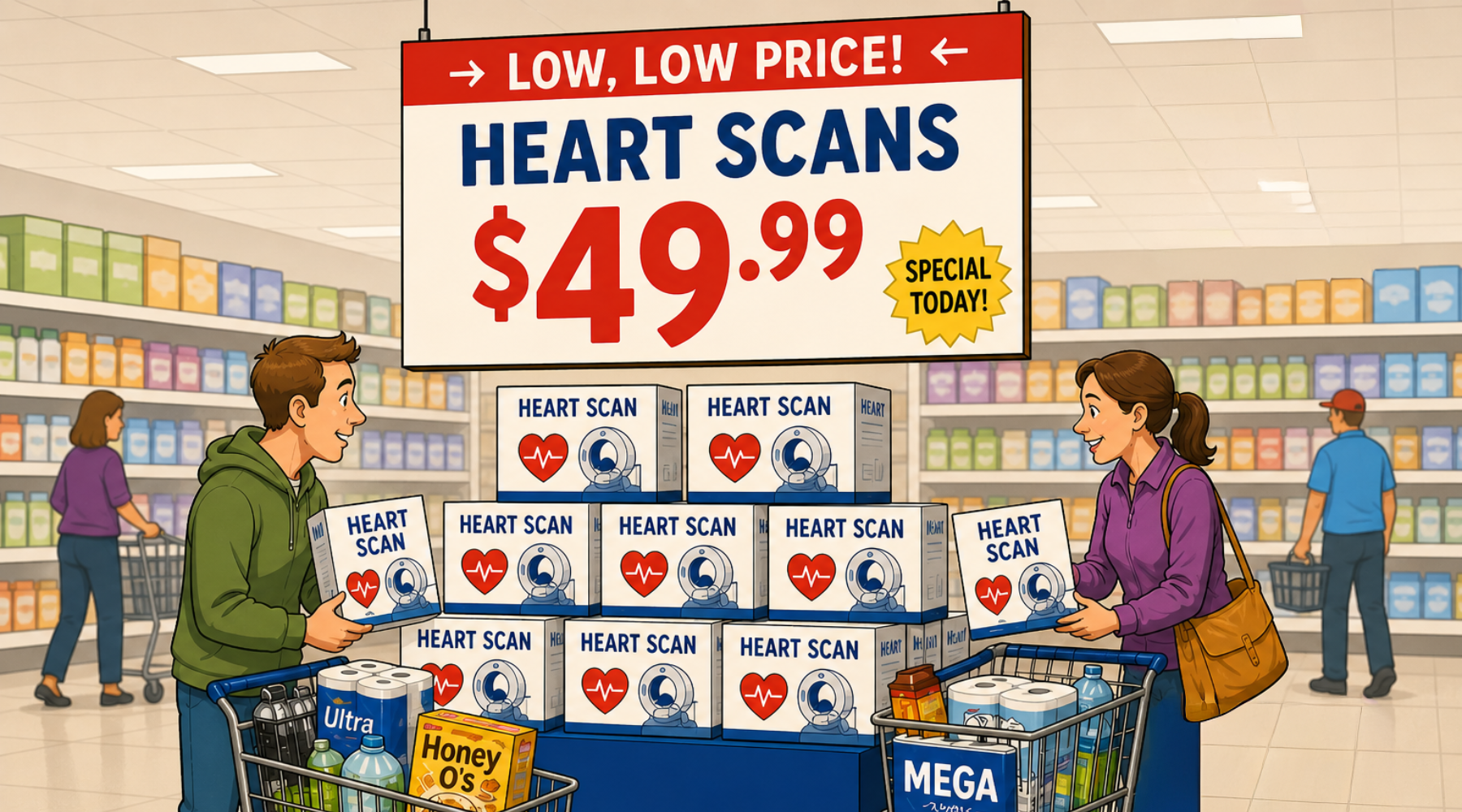
I’ve seen low-cost heart scans advertised at local hospitals. I’ve never had one, but should I? Should we all? How useful are they?
Dr. Scofield Prescribes
You’re most likely talking about a coronary artery calcium scan. These quick, noninvasive tests, widely available for as little as $50, use a type of computed tomography (CT) scan to measure calcified plaque in the coronary arteries.
These are the arteries that supply blood to the heart. Plaque buildup in these arteries, known as coronary artery disease, is a leading cause of heart attacks.
For some people, these scans can be quite helpful. They’re most useful in those who don’t have any symptoms of cardiovascular disease (things like chest pain, shortness of breath, and dizziness) but nevertheless have an increased level of risk due to factors like high blood pressure or elevated cholesterol.
For folks in these “gray” areas, especially between the ages of 40 and 75, coronary artery scans can help tip the balance on whether a person should start taking a statin drug. For instance, someone with elevated cholesterol who shows moderate plaque buildup might be advised to begin statins, while someone who shows no detectable calcified plaque might be advised to wait and focus instead on lifestyle changes.
Coronary calcium scans, though, are not a one-size-fits-all solution.
Unless there is some special circumstance, like a strong family history of heart disease, the test is not recommended as routine screening for very low-risk people. And at the other end of the spectrum — those who have established coronary disease, those already known to be at high risk, and those who have experienced symptoms — the scans add little useful information to inform the treatment path.
Plus, these tests do expose you to radiation, and there is no safe dose of radiation. And if every person got one – as some advertising seems to suggest – the cost would run well into the billions.
Still, these inexpensive, noninvasive scans can be useful in borderline cases, helping to determine whether a person needs a cholesterol-lowering medication. If you believe you might fit into this category, talk to your healthcare provider to see if a coronary artery calcium scan makes sense for you.
–
Dr. Hal Scofield is a physician-scientist at the Oklahoma Medical Research Foundation, and he also serves as Associate Chief of Staff for Research at the Oklahoma City VA Medical Center. Adam Cohen is OMRF’s senior vice president and general counsel. Send your health questions to contact@omrf.org.